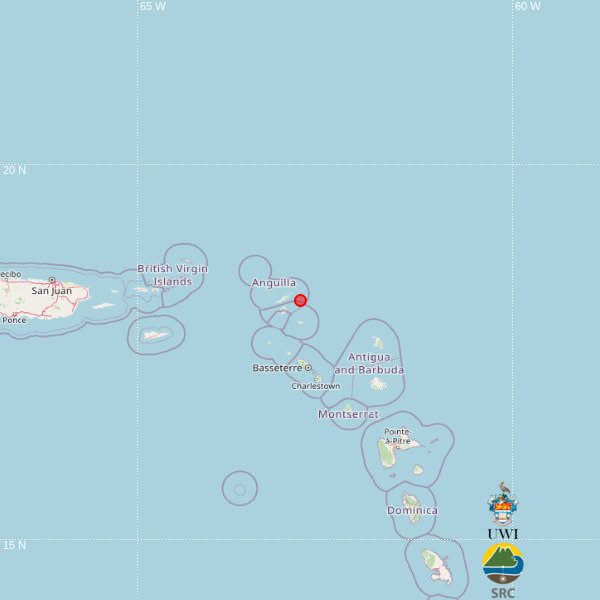
ST. JOHN’S, Antigua – On the afternoon of Tuesday, November 10, 2026, a low-magnitude seismic event was registered in the marine zone northeast of Antigua and Barbuda, per preliminary monitoring data shared by the University of the West Indies Seismic Research Centre (UWI-SRC), the leading regional authority on Caribbean seismic tracking. The tremor struck precisely at 1:48 p.m. local time, originating 27 kilometers beneath the Earth’s surface, a relatively shallow depth typical of many low-intensity quakes in the Eastern Caribbean tectonic zone. Geospatial calculations pin the preliminary epicenter at 18.20 degrees north latitude and 62.83 degrees west longitude, placing it roughly 162 kilometers from Antigua and Barbuda’s capital city of St. John’s, around 100 kilometers away from Basseterre, the capital of St. Kitts and Nevis, and approximately 170 kilometers from Brades, the administrative seat of Montserrat. As of the UWI-SRC’s initial public advisory, no incoming submissions of structural damage, personal injuries, or secondary hazards such as small local tsunamis have been confirmed across the affected nearby island nations. The regional seismic body also issued a standard procedural note to the public, clarifying that the currently published magnitude and exact location metrics were generated in real time via automated computer processing pipelines, and are not final official figures. Teams of UWI-SRC seismologists are conducting cross-verification against data from the network of regional seismic monitoring stations, and may release updated, adjusted parameters in the coming hours if discrepancies are identified. The advisory context notes that frequent minor to moderate seismic activity is a longstanding geophysical characteristic of the Eastern Caribbean, driven by the constant, gradual collision and sliding of the Caribbean Tectonic Plate against the North American Tectonic Plate, a geological dynamic that has shaped the region’s island archipelago for millions of years.