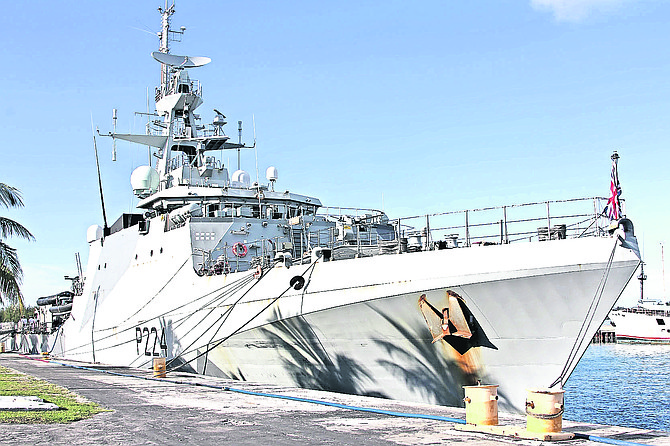
Freeport Harbour, Grand Bahama – The Royal Navy’s River-class offshore patrol vessel HMS Trent, a multi-mission craft equipped with an on-board drone squadron and specialist commando engineering teams, docked in Grand Bahama on Monday for a three-day official visit, as part of the UK military’s ongoing Atlantic Patrol Tasking regional deployment. The vessel, which previously supported post-Hurricane Melissa recovery operations in Jamaica last year, is one of five permanently forward-deployed Royal Navy patrol ships stationed across global strategic zones spanning the Caribbean, Pacific, Falkland Islands, Mediterranean and northern European waters, designed to sustain consistent collaborative ties with regional allies. High-ranking Bahamian government and defence officials, including Minister of National Security Myles LaRoda, Minister of Urban Renewal and Community Relations Lisa Rahming, and Royal Bahamas Defence Force Commodore Floyd Moxey, were hosted aboard the vessel for closed-door discussions focused on deepening bilateral UK-Bahamas security cooperation, joined by British High Commissioner to The Bahamas Smita Rossetti and Deputy High Commissioner Ryan Griffin. During the engagements, LaRoda highlighted that the patrol ship’s drone-enabled supply delivery capability to hard-to-reach, remote communities was of particular strategic interest to The Bahamas, as the nation sits in the notorious “Hurricane Alley” weather corridor and faces a six-month annual hurricane season. He noted that the Bahamian government is actively exploring pathways to build domestic capacity in drone-assisted disaster response, leveraging both its own decades of experience navigating extreme storm events and the expertise of international partner nations. HMS Trent’s Commanding Officer, Commander Gavin Lowe, outlined three core priorities for the current Caribbean deployment: co-developing natural disaster response protocols with regional partners, cementing long-term defence cooperation frameworks, and disrupting transnational illicit trafficking operations including narcotics smuggling. Lowe framed the vessel’s post-disaster operational role as a mobile “triage unit”: its embedded commando engineering teams are trained to rapidly restore broken communications networks, clear debris from critical airfields, repair damaged heavy machinery, and bring essential public infrastructure back online, while the ship carries pre-stocked humanitarian relief supplies and can generate up to 16 tonnes of fresh potable water per day for affected populations. Recounting the vessel’s recent disaster response track record, Lowe noted that HMS Trent was initially positioned near the Turks and Caicos Islands as Hurricane Melissa approached the territory last year, before being rerouted immediately when the storm shifted course to make landfall in Jamaica. Over five days of offshore operations off Jamaica, the crew produced emergency fresh water, deployed response teams ashore, and delivered on-the-ground support to a local hospital and public school. The 90-person complement aboard HMS Trent includes active duty naval personnel, embarked commando troops, specialist engineering units, and a dedicated drone squadron, all configured to amplify the vessel’s emergency response capabilities during hurricanes and other regional crises. Lowe also disclosed that over the past two years, the patrol ship’s counter-narcotics operations have led to the seizure of nearly 10 tonnes of cocaine, with an estimated collective street value approaching US$1 billion, the majority of which were intercepted in 2024 and 2025. He emphasized that the vessel’s current operational focus has shifted from active interdiction to collaborative capacity building, noting that in-person visits to Caribbean nations allow Royal Navy teams to map existing local disaster response systems rather than imposing external protocols, while also identifying opportunities for cross-regional peer support, shared expertise, and improved pre-emergency coordination. High Commissioner Rossetti echoed this collaborative framing, noting that the visit marks another milestone in the long-standing UK-Bahamas defence and security partnership, which includes ongoing personnel training placements for Royal Bahamas Defence Force officers at the UK’s Britannia Royal Naval College in Dartmouth, and builds on the substantial UK humanitarian support delivered to The Bahamas in the aftermath of catastrophic Hurricane Dorian. Beyond official bilateral talks, the HMS Trent crew is scheduled to hold working sessions with Bahamian disaster risk management officials, visit local primary and secondary schools, and compete in a friendly rugby match with local community teams. On Tuesday, youth groups including Brownies, Scouts, Cadets and Rangers will be hosted for guided tours of the vessel, before HMS Trent departs Grand Bahama on Thursday to resume its regional deployment.