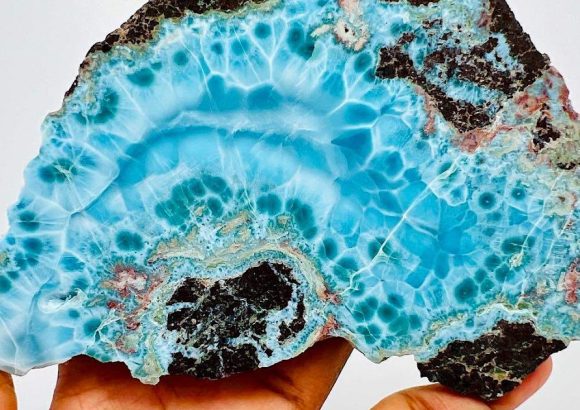
Santo Domingo, Dominican Republic – The Dominican Republic is rolling out a one-of-a-kind end-to-end digital traceability system for its iconic native semi-precious gemstone, larimar, slated to go live in 2027, creating a fully transparent verification tool for both commercial stakeholders and end consumers to confirm a stone’s legitimacy, exact extraction origin, and every step of its journey from mine to finished jewelry or art piece.
This landmark initiative is a collaborative project led by the Ministry of Energy and Mines (MEM), the National Office of Industrial Property (ONAPI), and cross-sector representatives from the Regulatory Council of the “Larimar Barahona” Designation of Origin. The core goal of the framework is to fortify safeguards for the Dominican Republic’s only geographically exclusive semi-precious stone, while driving substantial gains in its perceived and actual market value across global luxury and gem trading circuits.
Golye Latoufe, MEM’s director of Mining Promotion and sitting president of the Larimar Barahona Regulatory Council, outlined the core mechanics of the platform: every batch of newly extracted larimar will be assigned a unique, non-duplicable identification code logged permanently to the centralized digital registry. Tracking starts the moment a gem is pulled from the earth, with each individual piece tagged to document the exact mine shaft it was sourced from before it leaves the extraction site.
As each larimar specimen advances through the subsequent stages of cutting, artisanal processing, wholesale distribution and final retail sale, supplementary verification markers, high-resolution imagery and transaction records will be added to its linked digital profile. Latoufe confirmed that every verified larimar piece will also be engraved with a permanent, corrosion-resistant marking engineered to remain legible for over a century, directly tied to the digital platform, enabling full, unbroken tracking of its ownership and movement across every node of the supply chain.
Beyond confirming authenticity for purchasers, the system will also grant full visibility into whether a given larimar stone was extracted and processed in full alignment with strict local environmental stewardship rules, sustainable mining guidelines, and worker safety protocols, a key selling point for ethically conscious global gem buyers.
ONAPI will administer the formal certification layer of the program: all businesses and independent artisans granted permission to use the protected “Larimar Barahona” Designation of Origin must hold official registration with the agency, and all valid certification documents will feature scannable QR codes that any user can cross-check in real time via ONAPI’s public online portal.
Latoufe emphasized that the new traceability infrastructure is purpose-built to elevate larimar’s market positioning into premium, high-value gem segments, granting the Dominican gem a standardized, globally recognized certification status on par with the verification systems used for world-famous luxury gemstones such as sapphires and rubies.
Currently, the “Larimar Barahona” Designation of Origin already holds formal legal protection in 29 countries, with active registration applications pending in high-priority markets including China, India, the United States and Ecuador. German regulatory approval is on track to be finalized in 2027, a milestone that will extend the geographic scope of the designation’s intellectual property protections to the entire European Union single market.
This global intellectual property milestone was formalized on July 24, 2025, when the World Intellectual Property Organization (WIPO) officially awarded the international registration of the “Larimar Barahona” Designation of Origin, with the formal certification document presented directly to Dominican Minister of Energy and Mines Joel Santos.
The cross-sector Regulatory Council holds full oversight responsibility for enforcing larimar’s authenticity benchmarks, quality control standards and compliance rules across both domestic and international markets, alongside managing designation of origin usage permits, and implementing targeted programs to strengthen every link in the larimar local value chain to support local mining communities and artisanal craft sectors.