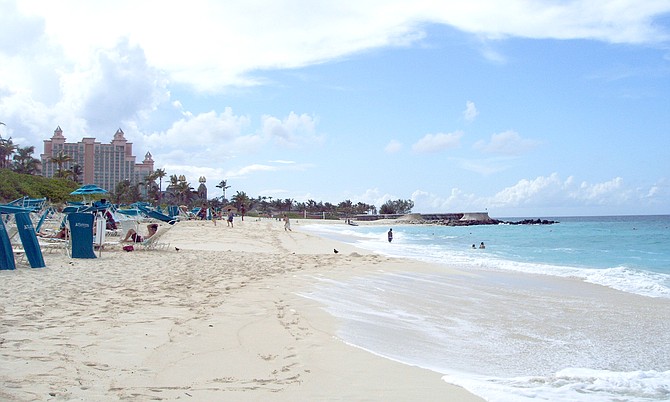
NASSAU, The Bahamas — After years of public scrutiny and community pushback over shoreline access and local livelihood protections, the long-debated $550 million Four Seasons Ocean Club Residences development on Paradise Island’s iconic Cabbage Beach has cleared all mandatory government regulatory approvals, top environmental officials confirmed this week, though no formal construction start date has been locked in as project backers work through remaining administrative loose ends.
Dr. Rhianna Neely-Murphy, Director of the Bahamas Department of Environmental Planning and Protection, updated local reporters on the project’s status yesterday, noting that while all cross-agency regulatory sign-offs are now finalized, developers still need to resolve a slate of outstanding administrative requirements before they can present a full, public-facing implementation roadmap to both the Bahamian public and government oversight bodies.
“Right now, the development team is working through the last set of administrative procedural matters. As soon as those are fully resolved, the Cabbage Beach development representatives will return to the Bahamian people and relevant government stakeholders to lay out a clear, step-by-step rollout plan for every phase of the project,” Dr. Neely-Murphy explained, adding that her department has not yet received a formal projected timeline from the developer to confirm when groundbreaking activities may commence.
Spanning a 6.1-acre parcel situated between the RIU Paradise Island resort and Sunrise Beach Villas, the proposed luxury development is set to include 67 high-end private residential units, but has been a flashpoint for community tension for years, centered on widespread public anxiety over unobstructed access to Cabbage Beach — a beloved public shoreline and critical income source for dozens of local Bahamian small vendors who rely on tourist foot traffic to sustain their livelihoods.
Public anger over the project boiled over this past summer, when contractors erected a full perimeter fence around the designated development site. The barrier sparked widespread vendor protests, with demonstrators arguing the structure blocked longstanding public pathways to the shore and posed an existential threat to their small businesses. The outcry prompted direct government mediation, with officials issuing public demands for the fence to be adjusted to preserve public coastal access.
As a temporary solution to avoid conflicts with upcoming site works, the affected Cabbage Beach vendors were temporarily relocated to Goodman’s Bay public beach on New Providence. But the stopgap relocation has sparked new frictions, as long-established Goodman’s Bay vendors have publicly accused the newly arrived group of encroaching on their pre-assigned vending zones and competing aggressively for tourist customers, in some cases leading to reports of harassment of visitors.
The formal development agreement, which was finalized as part of the approval process, enshrines legally binding protections for public shoreline access: the developer is required to maintain unobstructed public access to Cabbage Beach for the full duration of construction, including clearly marked alternative access routes if portions of the adjacent beachfront are temporarily disrupted by site works. Upon full completion of the project, the developer is also mandated to build and preserve a permanent 15-foot-wide public right-of-way along the shore, and existing local vendors will be given explicit priority consideration for licensed vending opportunities within the finished resort complex.
Even with the official approvals in place, however, lingering public concerns have not been fully resolved. Many local residents and vendors continue to raise questions about the transparency of the approval process, the robustness of temporary access plans during construction, and the exact mechanisms that will be used to guarantee vendor preference for on-site commercial spaces. As recently as October, local community advocacy group Dis We Beach issued a formal public call to the Bahamian government to proactively publish all of the project’s full environmental approval documents, ecological impact assessments, and detailed construction-phase beach access management plans for full public review.