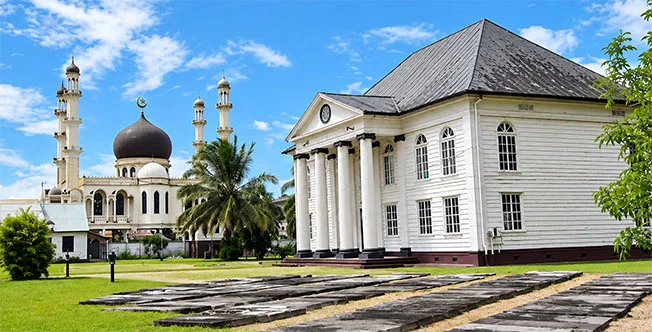
Two leading interfaith bodies in Suriname, the Committee of Christian Churches (CCK) and the Interreligious Council (IRIS), have formally reached out to newly inaugurated president Jennifer Simons with a detailed set of policy requests aimed at reversing the steady deterioration of the country’s vast stock of monumental religious and historic buildings. The joint initiative, outlined in an official letter dated for submission on November 5, 2024, follows a prior appeal the two organizations shared with the previous national administration on October 14, 2024, which they note has never been acted on despite the urgent, unresolved nature of the concerns raised.
Religious denominations across Suriname own a substantial share of the nation’s protected historic properties, spanning urban Paramaribo and rural districts. For decades, these communities have struggled to cover steep maintenance and full restoration costs for aging sites, as donations from congregations are legally and earmarked exclusively for core spiritual programming, leaving no surplus to fund specialized heritage construction work. The groups emphasize that the current 2002 Monuments Act imposes strict mandatory preservation obligations on private property owners, including religious institutions, but never delivered on corresponding state financial support mechanisms written into the original legislation. They also note that no religious or private heritage property stakeholders were consulted during the drafting of the existing 2002 law, creating an unbalanced regulatory framework.
The CCK and IRIS put forward five targeted, actionable proposals to address these gaps. First, they are calling on the national government to allocate a dedicated line item in the annual state budget for monumental building upkeep, citing Articles 10 and 11 of the 2002 Monuments Act that legally mandate such funding – a line item that the groups confirm has never been implemented in the 22 years since the law passed. Second, they are requesting that private heritage property owners, including religious organizations, be granted full access to grant and loan resources from the Inter-American Development Bank’s Paramaribo Urban Rehabilitation Program (PURP) and similar international heritage funding schemes. Third, the groups are pushing for targeted tax relief, including full value-added tax exemptions for all maintenance and restoration work on protected monuments and places of worship, alongside a zero-percent tariff rate for mandatory fire insurance policies for these heritage sites.
Fourth, the interfaith coalition is advocating for the official establishment of a dedicated national heritage management body, as explicitly permitted under Article 12 (1) of the 2002 Monuments Act via state decree. They are demanding that private property owners, who hold title to the vast majority of Suriname’s protected monuments, be granted equal, meaningful representation on the new institution’s governing board. Finally, the groups are calling for a full, participatory revision of the 2002 Monuments Act, with formal input from government agencies, private heritage owners, licensed architects, urban planners, and civil society stakeholders. The revised legislation, they note, must include formal appeal pathways for property owners contesting rulings issued by the national Monuments Care Commission, and embed a balanced framework that reconciles long-term cultural heritage preservation with sustainable urban development goals for growing cities like Paramaribo.
In their letter, signed by CCK representatives Reverend Runaldo Gallant and Bishop Karel Choennie, and IRIS chair Athmanand Ramcharan, the organizations stress that Suriname’s iconic interlinked religious heritage sites – including the adjacent historic mosque and synagogue in central Paramaribo, the city’s grand cathedral, Grote Stadskerk, Centrumkerk, and Maarten Lutherkerk – are foundational to Suriname’s unique multicultural national identity. These sites, they add, are major domestic and international tourist draws that drive local economic activity far beyond their religious function. The coalition acknowledges that the Surinamese government faces tight fiscal constraints and difficult budget tradeoffs, but reaffirms their willingness to collaborate with state officials to develop practical, cost-effective preservation solutions. They have formally requested a meeting with President Simons to send a delegation to elaborate on their proposals and negotiate next steps for national heritage protection.