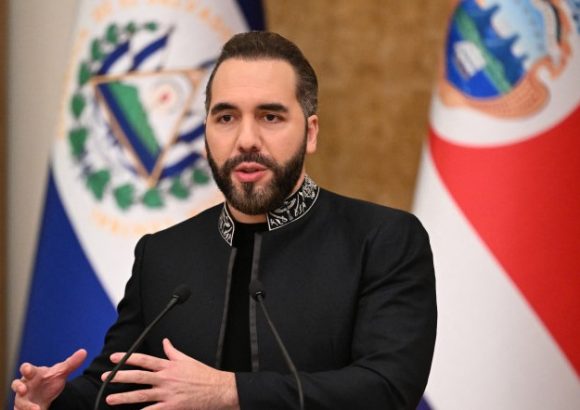
San Salvador, Nov. 12 (EFE) — Salvadoran head of state Nayib Bukele has publicly committed his administration’s full backing to Haiti’s national effort to oust violent armed gangs from all swathes of its sovereign territory, framing the fight against criminal networks as a defense of Haitian revolutionary heritage. In a Tuesday statement shared on social platform X, Bukele slammed gang operatives, their shadowy financial backers and illicit weapons traffickers as traitors to the legacy of Jean-Jacques Dessalines, the iconic leader who led Haiti to become the first independent Black republic in the Americas.
The president’s remarks came alongside confirmation that Salvadoran military rotorcraft had recently been deployed to repel a coordinated gang assault on Chadian troops assigned to the UN-backed Gang Suppression Force (GSF). Bukele asserted that the once-dominant armed criminal groups have now lost their tactical advantage across active security zones, marking a pivotal turning point in the months-long anti-gang campaign.
This public show of support aligns with a major expansion of El Salvador’s military footprint in Haiti, where more than 2,000 Salvadoran service members are now stationed. The deployment was initially launched to locate four Salvadoran military personnel who went missing on October 18 after their convoy came under fire in Croix-des-Bouquets, a community on the outskirts of Port-au-Prince. The four troops, all assigned to the UN-mandated GSF, were widely reported to have been abducted following the ambush.
Haitian Prime Minister Alix Didier Fils-Aimé, whose administration has laid out a formal policy to dismantle all organized criminal syndicates operating on national soil, extended official gratitude to Bukele for the tangible international assistance. Fils-Aimé stressed unequivocally that the Haitian government retains full political oversight and strategic command of all ongoing security operations, noting that the Haitian National Police, national armed forces and GSF units are operating under a unified, state-led operational framework to break gang power and restore full sovereign state authority across the country.
Regional coordination for the mission has also drawn in neighboring Dominican Republic, which has provided critical logistical backing to facilitate the transit of personnel, heavy equipment and urgent medical evacuation flights for deployed forces. Dominican President Luis Abinader, however, has explicitly ruled out any direct deployment of Dominican combat troops to active frontline operations, framing his country’s role as strictly supportive and non-combat.