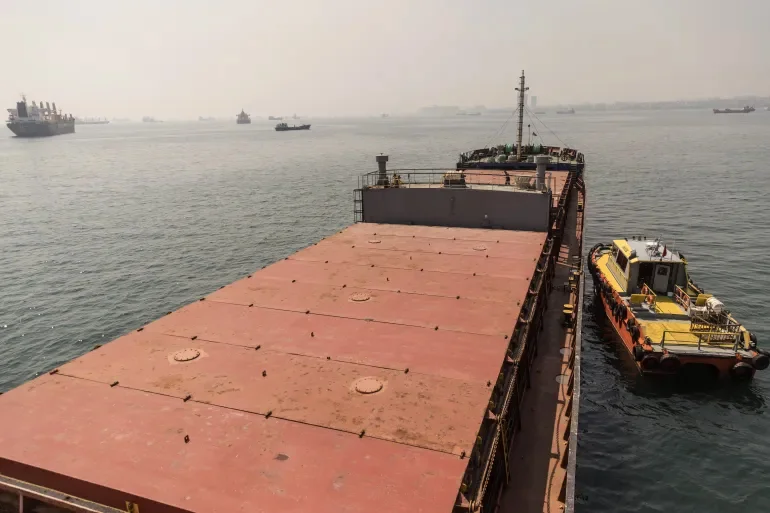
Istanbul, Turkey – A 2022 Getty Images file photo captures the deck of the MV Ramus, a cargo vessel carrying more than 6 tons of Ukrainian wheat, ahead of a scheduled port inspection in August that year. What was once a routine maritime check now serves as a stark reminder of the fragile state of global grain supply chains, as ongoing conflicts in the Black Sea region push international food security to unprecedented levels of strain.
Over recent months, rising targeted attacks on commercial shipping and port infrastructure across the Black Sea have turned critical agricultural export routes into active zones of economic warfare, severely curtailing the grain export capacity of Russia and Ukraine – the world’s two top wheat suppliers, which together account for roughly 27% of total global wheat exports. Prior to the outbreak of full-scale hostilities, Ukrainian Black Sea ports handled 90% of the country’s total agricultural exports, but repeated Russian assaults on port facilities and passing cargo vessels have rendered these historic routes largely unusable. Ukraine has attempted to redirect its grain flows via alternative overland and inland waterway corridors, including transit along the Danube River to Romanian ports, followed by onward shipment to global markets via rail and road networks across EU member states. Even these backup routes, however, have become increasingly vulnerable to cross-border strikes, driving up transport costs and eroding supply reliability.
Official trade data published by Reuters on November 3 reveals the staggering scale of export declines: Russian grain shipments through the Black Sea and Sea of Azov plummeted to just 300,000 tons in September 2024, a 93% drop from the 4.74 million tons recorded in the same month the previous year. Ukrainian grain exports through its remaining operational ports also fell sharply to 810,000 tons, down from 2.1 million tons in September 2023. The geographic scope of attacks has expanded far beyond the immediate front lines of the Russia-Ukraine conflict: in early October, a cargo vessel carrying corn was struck in the Romanian exclusive economic zone, killing two crew members and prompting emergency rescue operations for 11 other seafarers, while additional commercial ships were damaged in Bulgarian territorial waters shortly after. Ukraine has also ramped up strikes on Russian maritime infrastructure, damaging grain export terminals along the Black Sea and Sea of Azov and forcing Moscow to reroute a large share of its agricultural exports to Baltic Sea ports and other distant alternative corridors.
The surge in attacks on vessels sailing near NATO member state territorial waters has prompted the 31-nation military alliance to announce a major expansion of its eastern Black Sea maritime presence, as confirmed in a November 3 Reuters report. NATO will deploy additional maritime patrol aircraft, long-range radar systems and surveillance drones to monitor shipping lanes and reduce collision and attack risks for civilian vessels. The move comes as the rising number of cross-border incidents stoke new tensions between the alliance and Moscow.
Analysts warn that the disruptions are set to persist for at least another three months, according to a S&P Global assessment released on October 29. The supply crunch is compounded by parallel global concerns over drought-driven weak harvests in major grain-producing regions, creating a perfect storm of upward pressure on international food prices. Low-income nations in Africa and the Middle East, which rely on Russian and Ukrainian wheat for the vast majority of their domestic consumption, face the most severe risks, as they are forced to source grain from more distant, higher-cost alternative suppliers. Many of these nations maintain heavy food subsidy programs to keep staple prices affordable for vulnerable populations, and rising import costs are set to put unprecedented strain on national government budgets. Even small, geographically distant import-dependent nations such as Suriname are not insulated from the spillover effects: while no immediate domestic food shortages are projected, elevated international grain prices, combined with soaring marine insurance and freight charges, will eventually push up costs for imported staple foods, raising overall household living expenses.
The UN-backed Agricultural Market Information System noted in its October update that global grain stockpiles remain relatively robust, and global import demand is currently moderate, creating a buffer that prevents an immediate full-scale global food crisis. Nevertheless, sustained supply chain disruptions will continue to push up food costs for millions of households worldwide, highlighting how a regional conflict thousands of miles away can ripple out to impact livelihoods across every continent.
Aanvallen op graanschepen bedreigen wereldwijde voedselzekerheid