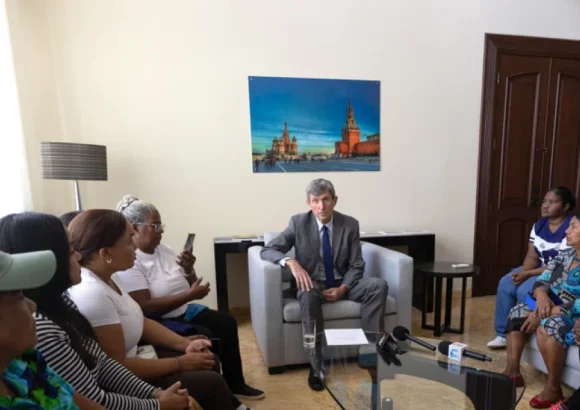
In the Dominican capital of Santo Domingo, a group of family members of Dominican nationals who were recruited by Russia in the context of the ongoing Ukraine conflict held a formal meeting with Russian Ambassador Alexey Victorovich Serendin on a recent Monday, pressing for full transparency on the whereabouts of their loved ones and urgent support to facilitate their safe return to the Caribbean nation. The group had initially organized a public prayer vigil scheduled to take place outside the Russian diplomatic mission to raise awareness of their relatives’ plight, but opted to cancel the planned demonstration immediately after the ambassador agreed to receive them for direct talks. The family members assert that scores of Dominican citizens traveled to Russia after signing what they believed were legitimate civilian work contracts, with no advance knowledge that they would be deployed to frontline combat roles in the Ukraine war. Beatriz Melo, whose relative Juan Ramirez is one of the caught-up recruits, shared that Ramirez has been stationed in Russia for over two months, and recently reached out to the family to inform them he was undergoing combat training ahead of deployment. Melo emphasized that Ramirez was deliberately deceived about the true nature of his trip, and relayed his accounts of harsh, inhumane living conditions including extreme cold, insufficient food rations, and physical mistreatment at the hands of those overseeing the recruits. Carlos Sánchez Díaz, coordinator for the Southern Region chapter of the Dominican Committee for Human Rights, estimates that roughly 150 Dominican nationals are currently serving in Russian military capacities amid the Ukraine conflict, with more than 50 of that group actively attempting to exit military service and return to their home country. Sánchez Díaz has publicly called for a full, formal review of the recruits’ contractual terms and legal standing, aligned with both Dominican national law and binding international human rights frameworks. During the closed-door meeting with the families, Ambassador Serendin confirmed that the Russian embassy will maintain an open line of communication to support the group, and stated that Russia’s Defense Ministry clearly outlines all terms of its military recruitment contracts to signatories. At the same time, he conceded that the circumstances under which Dominican nationals were initially approached and persuaded to travel to Russia represent a separate, distinct matter from the formal contracts signed on arrival. The ambassador also noted that the diplomatic mission is in ongoing coordination with the Dominican Republic’s Ministry of Foreign Affairs, which has already dispatched a dedicated working delegation to Russia to resolve the complex situation involving its nationals. As of last month, the Dominican government had retained specialized local legal counsel based in Russia to evaluate the legal status of all its citizens caught up in the recruitment scheme, and successfully coordinated the repatriation of four Dominican nationals who refused to sign military service contracts immediately after arriving on Russian soil.