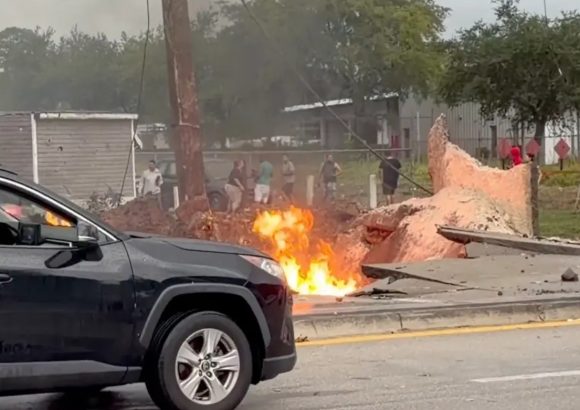
A routine cross-country private business flight devolved into a deadly disaster on a Sunday afternoon in Palm Beach County, Florida, when a twin-engine Learjet 60 carrying nine people plunged at extreme velocity into a busy mixed commercial and residential neighborhood, igniting a massive, all-consuming fireball that sent plumes of thick black smoke billowing across the skyline. Federal aviation officials have confirmed that every person on board the aircraft died on impact, with no survivors reported from the flight. The ill-fated jet had taken off earlier that day from Austin-Bergstrom International Airport in Texas, bound for a destination in the Bahamas, before it suffered a sudden, catastrophic loss of altitude as it traversed airspace over South Florida. The crash unfolded at roughly 12:50 p.m. Eastern Standard Time, when the aircraft slammed into the paved surface of Military Trail — a high-traffic thoroughfare lined with homes and retail establishments near the community of Greenacres, situated only six miles from former President Donald Trump’s Mar-a-Lago private estate. Newly unsealed air traffic control audio recordings lay bare the terrifying, fast-unfolding final minutes of the flight, capturing the pilot’s rapid shift from routine communication to unbridled panic. Moments after air traffic controllers alerted the crew to moderate turbulence in the surrounding atmosphere, the female pilot transmitted her first distress call, shouting, “Seven two two bravo delta, we’re descending 8,000… Mayday, Mayday… we’re descending 10,000 feet per minute!” Within seconds, the situation deteriorated even further, as the pilot reported a dangerous overspeed condition that was eroding any remaining control of the aircraft, yelling, “Declaring emergency, declaring emergency… Descending 20,000 feet per minute… we’re going to crash into the ground!” Even as the attending air traffic controller attempted to calm the crew and maintain communication, calling out, “I’m here with you, talk to me,” the final transmission from the cockpit painted a grim picture of total systems failure: “We are descending 22,000 feet, and we are banking 60 degrees. We’re out of time!” Independent ADS-B flight tracking data corroborates the harrowing timeline, showing the jet plummeting from a cruising altitude of more than 35,000 feet to under 9,000 feet in a span of just over 60 seconds before entering a fatal nosedive toward the ground. Dozens of local eyewitnesses described a scene of unprecedented chaos, with many reporting a deafening, missile-like roar passing directly overhead immediately before a massive blast rattled homes for multiple surrounding blocks. The impact sheared through tree canopies, ripped overhead power lines from their supports, carved a deep crater into the asphalt of Military Trail, and scorched nearby residential and commercial property. One Greenacres resident shared their account on a local community forum, writing, “We lost power right after a massive boom, and suddenly there were dozens of sirens rushing down the road. It sounded just like a missile going off.” Palm Beach County Fire Rescue immediately activated a mass casualty incident protocol upon arrival at the scene, shutting down all northbound and southbound lanes of Military Trail between Cresthaven Boulevard and 10th Avenue North to give first responders space to extinguish secondary fires and secure the sprawling debris field. U.S. Transportation Secretary Sean Duffy released an official statement extending deep condolences to the families and loved ones of the nine crash victims, confirming that the Federal Aviation Administration had deployed a specialized team of technical experts to support the National Transportation Safety Board’s lead investigation. As of press time, officials have not yet confirmed if any bystanders on the ground suffered injuries in the crash, and NTSB investigative teams have indicated their initial probe will prioritize examining in-flight weather data — including verified reports of turbulence and potential atmospheric icing — alongside inspections for possible mechanical or structural failures that could have triggered the loss of control.