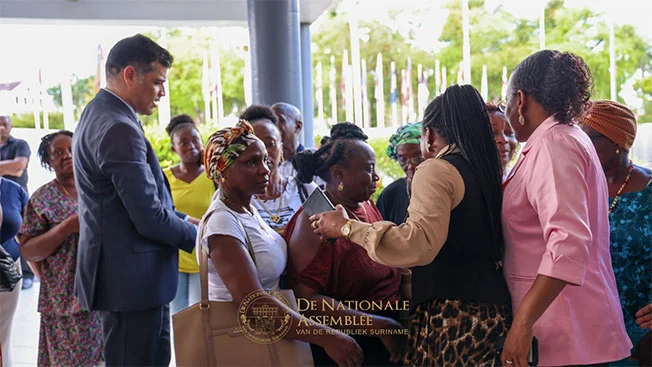
Dozens of families residing in Suriname’s Sunnypoint Block 2, some of whom have called the neighborhood home for more than 25 years, are facing escalating threats of forced displacement as external groups lay competing claims to the land they have developed for decades. Facing sustained verbal intimidation, physical aggression, and targeted harassment from parties asserting unrecognized land rights, the community has formally submitted a collective petition to the National Assembly of Suriname (DNA) on November 1, pleading for urgent state intervention to safeguard their safety and formalize their long-held residency rights.
Many of these households first settled in the area starting in 2000, amid a widespread national housing shortage that pushed thousands of families to seek affordable, unused land on the city’s peripheries. Operating with no prior state support, these residents invested their own personal funds to build permanent homes, clear and service vacant lots, and establish a tight-knit neighborhood with shared community infrastructure, even as the formal legal status of the land parcels remained tangled in bureaucratic ambiguity. For generations, the area operated as a peaceful, self-sustaining residential zone, but recent months have seen a sharp breakdown in public order, as unknown outside actors have arrived to stake sudden claims to properties that families have occupied for decades.
The petition, read aloud by community representative Alex Sampi, outlines the growing crisis of fear gripping the neighborhood, noting that the safety of vulnerable groups including young children and elderly residents is now at immediate, severe risk. Community leaders are calling on two key government ministries — the Ministry of Land Policy and Forest Management, and the Ministry of Justice and Security — to fulfill their official duties by launching a full, transparent audit of all land claims in Sunnypoint Block 2, deploying law enforcement to restore public order, and rolling out a phased administrative legalization process to formalize residency rights for long-term, eligible residents. The group has also requested formal state-mediated negotiations between the established community, competing land claimants, and government officials to de-escalate tensions and avoid violent conflict.
Representatives for the community emphasized their commitment to a fully peaceful, collaborative resolution, noting they are prepared to submit a complete, verified registry of all long-term resident households to the National Assembly, and have extended a public invitation to all members of parliament to visit Sunnypoint Block 2 to witness the on-the-ground conditions firsthand. Community spokesperson Ronald Pansa stressed that residents are not seeking empty gestures, but tangible, timely policy action to resolve the decades-long legal limbo.
During the formal petition handover, witnessed by multiple sitting members of parliament, lawmaker Steven Reyme of the A20 party echoed the community’s demands, noting that 25 years of unresolved land tenure uncertainty is a failure of state governance that has left thousands of families exposed to exploitation and violence. Reyme also highlighted a parallel unmet public service need for Sunnypoint residents, noting that the state-owned Surinaamsche Waterleiding Maatschappij (SWM) has already installed running water infrastructure in adjacent Block 3, and calling on the government to extend the same safe, piped drinking water access to households in Blocks 1 and 2.
National Assembly Chair Ashwin Adhin reaffirmed that the legislature, as the official representative body for all Surinamese citizens, will prioritize mediation and intervention to protect vulnerable communities facing displacement. A full copy of the petition was also delivered to Bronto Somohardjo, chair of the parliament’s standing committee for Land Policy and Forest Management, who confirmed the issue will be placed on the committee’s formal agenda for public review and follow-up deliberation. For the hundreds of Sunnypoint Block 2 residents, the pending government response will determine not just the formal legal status of their land, but the long-term safety, stability, and future of the multi-generational community they built from scratch over 25 years.