Santo Domingo – The Dominican Republic has stepped into a formal logistical support role to back El Salvador’s unprecedented military operation in Haiti, launched after four Salvadoran aeronautical technicians vanished on October 18 following a violent gang ambush. President Nayib Bukele of El Salvador has authorized the mobilization of over 2,000 troops for the mission, framing it first and foremost as a rescue effort for the missing citizens.
Dominican officials have explicitly confirmed their partnership framework, which covers streamlined transit clearance for international military contingents, cross-border transfer of heavy military hardware, dedicated medical evacuation capacity, and coordinated intelligence sharing – all while emphasizing that no Dominican armed forces personnel will participate directly in active combat operations on Haitian soil. President Luis Abinader first announced the bilateral coordination on October 24, disclosing that he had held direct talks with Bukele to align support measures tailored to the fast-deteriorating security situation in the neighboring Caribbean nation.
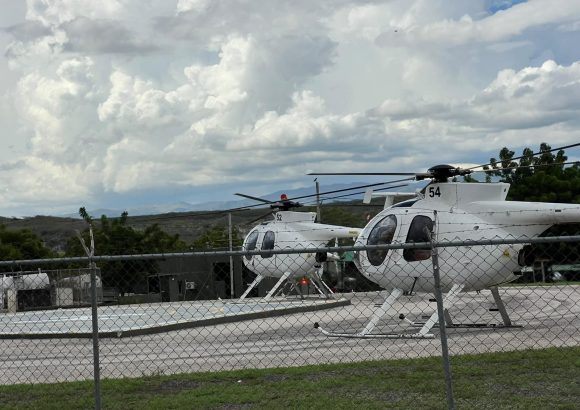
A visible marker of the joint coordination unfolded recently when a fleet of seven military helicopters made a scheduled refueling stop at El Rodeo fortress in Jimaní, a municipality in the Dominican Republic’s Independencia province that sits directly on the Haiti border, before proceeding onward to Haitian airspace. The fleet included five Salvadoran MD500E light attack helicopters, marked with identification numbers 48, 49, 52, 53 and 54, plus two U.S.-manufactured Sikorsky UH-60 Black Hawk multi-purpose utility helicopters. The versatile Black Hawk platform is designed to execute a wide range of military tasks, from troop transport and supply runs to medical evacuation, search and rescue, and direct combat support.
Official timelines verified by local Dominican outlet Diario Libre show the five Salvadoran MD500E helicopters first arrived at Las Américas International Airport outside Santo Domingo in the early hours of October 28, transported all the way from San Salvador aboard a Boeing 747-400 cargo jet operated by U.S.-based carrier National Airlines. The five MD500Es touched down at the Jimaní border fortress at 3:45 p.m. local time on the day of the cross-border flight, followed 25 minutes later by the two Black Hawks. After a rapid refueling stop, all seven aircraft departed for Haitian territory at 5:00 p.m.
As the deployment moves forward, Bukele has moved aggressively to push back against widespread regional speculation that the operation constitutes an unauthorized foreign incursion into Haitian sovereign territory. In a public message recorded and posted in Haitian Creole to his official X social media account, Bukele addressed the Haitian people directly to reassure them the mission is not hostile to local communities. “This is not an operation against the Haitian people, nor an invasion of the country of Haiti,” he stated emphatically, adding that El Salvador has no strategic interest in occupying Haitian land, seizing national resources, or dominating the local population. He noted that El Salvador is covering the vast majority of the operation’s costs, and that all deployed troops will return home immediately once the missing technicians are located and recovered. He also framed the operation as a targeted strike against violent criminal gangs that have been terrorizing ordinary Haitian civilians, stating “We are teaching the gangs a lesson.”
Tragic new developments on the humanitarian front have underscored the extreme risk facing aid workers operating in Haiti’s gang-controlled capital Port-au-Prince. The Norwegian Refugee Council (NRC) confirmed in a public statement that two of its local Haitian staff, Bonaparte Février and Richard Alexandre, were brutally murdered overnight on October 27 in Port-au-Prince. The organization did not release full details of the attack or identify suspected perpetrators, but NRC Secretary General Jan Egeland issued a forceful condemnation of the killings. Egeland called on Haitian national authorities and the broader international community to take urgent action to protect civilian populations and prevent further targeted violence against aid workers, noting that the two slain young men had dedicated their work to reducing suffering for vulnerable Haitian communities. He confirmed that the NRC will not abandon its on-the-ground humanitarian mission in the country despite the deadly security risks.
Dominican Foreign Minister Víctor “Ito” Bisonó later expanded on the scope of his country’s non-combat support role, noting that Dominican authorities will also facilitate unimpeded transit for humanitarian air operations, emergency medical evacuations for both civilians and deployed military personnel, and dedicated shipments of blood supplies and other critical life-saving resources. Bisonó explained that these support measures are designed to work around widespread operational bottlenecks that have left most Haitian ports and airports largely non-functional due to gang control, and reaffirmed that the Dominican Republic’s involvement will remain strictly limited to diplomatic, humanitarian and logistical lines, with no ground troops joining anti-gang combat operations.