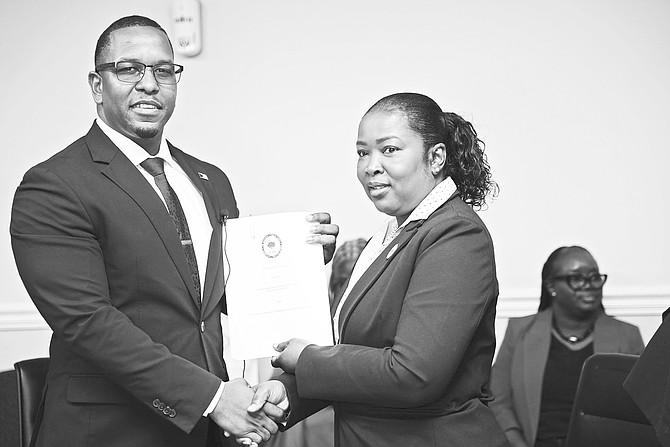
A landmark five-year collective industrial agreement, the first of its kind for staff at the Bahamas Public Parks and Public Beaches Authority, was formally executed yesterday between the public agency and the Bahamas Communications and Public Officers Union (BCPOU), representing 237 full-time employees across the country. While leadership from both entities confirmed a suite of new, long-unavailable workplace benefits for the workforce, they have opted not to release the full monetary value of the compensation package, citing safety concerns for the large share of outdoor-facing staff who maintain public recreational spaces. The new regulatory framework for employment terms retroactively took effect on January 1, 2026, and will govern all working conditions for the represented staff through the end of 2030. BCPOU President Sherry Benjamin explained that the union made the deliberate decision to withhold specific financial figures to protect members, many of whom perform high-exposure outdoor work in public parks and beach sites that are not always fully secured. The newly ratified agreement introduces a series of transformative workplace upgrades that did not exist for the authority’s staff prior to this deal: formal hazard pay for high-risk work assignments, expanded maternity benefits, and a brand-new paternity leave policy for male employees, alongside a standardized, transparent formal grievance process to resolve workplace disputes without arbitrary administrative pushback. Benjamin framed the signing as a watershed moment for the bargaining unit, noting that negotiations kicked off in late 2024, shortly after the union received formal certification to represent the authority’s staff. While both sides had reached a preliminary consensus on the full financial compensation package earlier in 2025, the finalization process dragged on far longer than anticipated, a delay Benjamin described as deeply disheartening for workers who had waited years for formal employment protections. She specifically credited the recently appointed Executive Chairman of the authority, Jamahl Strachan, for stepping in to break remaining impasses and push the deal across the finish line. For his part, Strachan emphasized that the new collective bargaining framework codifies mutual, clearly defined responsibilities for both the agency and its staff, embedding principles of collaborative consultation and equitable treatment into the authority’s operational culture as it undergoes a broader modernization push. He noted that the agreement also lays the groundwork for structured internal career advancement pathways for existing employees, ensuring the agency can leverage the on-the-ground expertise of its long-serving frontline teams as it scales up public space improvement projects. Parallel to the labor agreement announcement, Strachan confirmed that the authority is accelerating its national park restoration rollout: five public parks have already completed full upgrades, months ahead of the original September launch timeline for the programme, with five additional sites on track to be finished by the end of the first quarter of 2026 to bring the total number of refurbished recreational spaces to 10. The entire restoration initiative is being funded through the authority’s $32 million annual operating budget, rather than a separate, earmarked government allocation. Strachan also disclosed that the agency’s full independent annual audit has been finalized, and all related documentation will be formally submitted for public review in the appropriate government channels in the near future.