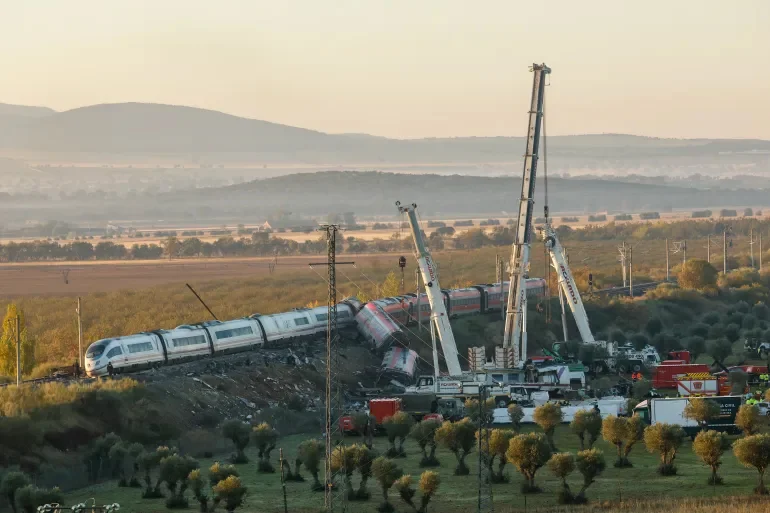
On October 29, emergency and recovery teams continued exhaustive search and clearance operations at a crash site near Urda, in Toledo province south of Madrid, where two high-speed passenger trains collided just before 9 a.m. the previous day, leaving a confirmed 69 people dead and over 100 others injured. The catastrophic incident unfolded when a Renfe-operated high-speed train traveling from Madrid to Sevilla struck the rear of a stationary Iryo private rail service, also bound for the Andalusian capital. The Renfe train was carrying 397 passengers and crew, while the Iryo service held 147 people at the time of impact; multiple carriages derailed in the collision, with two Iryo carriages tumbling down an embankment that significantly complicated first responder access to trapped victims. Early preliminary findings point to a critical combination of a technical system failure and misjudged directives from Madrid-based rail infrastructure manager Adif’s traffic control center, according to Spanish Transport Minister Óscar Puente. At approximately 8:30 a.m., the 1992-vintage LZB automatic safety system, which monitors train spacing to prevent collisions, suffered a total computer malfunction that automatically halted all services across a 63-kilometer stretch of the Madrid-Sevilla high-speed line. When human controllers took over manual operations to resume service, they granted the Renfe train permission to travel at full operating speed at 8:36 a.m., and shortly after instructed the Iryo train to restart its journey — even as the Iryo driver reported to dispatch that their train was unable to move. The Renfe service proceeded at normal speed until it crashed into the idling Iryo train at 8:53 a.m. Minister Puente publicly described the decision to allow the Renfe train to travel at full speed under these conditions as “unfathomable,” noting that all services should have been restricted to very low speeds following the automated safety system outage to give drivers sufficient time to react to unforeseen obstacles. A multi-agency investigation led by the Spanish Guardia Civil, judicial authorities, and the independent national rail accident review body is now underway, with officials interviewing all on-duty traffic control staff, analyzing black box data from both trains, and cross-referencing all communications between drivers and dispatch to pinpoint exactly what information controllers had access to at every stage of the incident, and why the Renfe train’s full-speed authorization was never revoked after the Iryo train was confirmed to be stranded. This disaster marks one of the deadliest rail accidents in Europe in recent decades, and the second fatal high-speed rail crash in Spain in 2026, following a January collision near Adamuz in Córdoba province that killed 46 people. Prime Minister Pedro Sánchez has stated there is no immediate evidence linking the two incidents, but called the occurrence of two mass casualty rail disasters in a single year “completely unacceptable.” The aging Madrid-Sevilla line still relies on the decades-old LZB safety system, with rollout of the modern European standard ERTMS safety platform still pending completion, a gap that rail worker unions have repeatedly flagged for years. Unions have renewed public calls for far greater targeted investment in rail safety infrastructure and updated, standardized emergency protocols for staff to follow when automated safety systems fail. In the wake of the crash, all high-speed services between Madrid and Andalusia have been suspended, with Renfe arranging substitute road transport for stranded passengers. The Spanish government has declared three full days of national mourning starting October 30, while Sánchez has suspended all upcoming campaign events ahead of the November 29 general election to oversee the emergency response and full investigation. Opposition political parties have demanded a fully transparent, independent public review to assign clear accountability for the fatal control room decisions that led to the collision.
Treinramp in Spanje eist minstens 69 levens, onderzoek richt zich op verkeersleiding