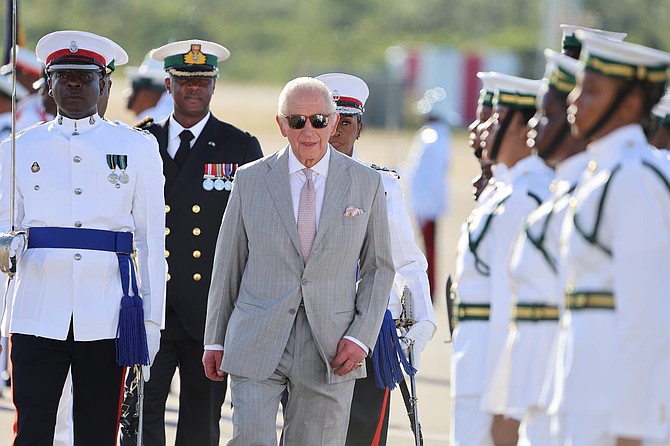
King Charles III made a memorable, culturally attuned entrance to a youth-focused rally at Nassau’s Clifford Park during his first 2024 visit to The Bahamas, opening his remarks with the beloved local Bahamian dialect greeting “I reach. Amen” – a phrase translating to “I have arrived” that immediately sparked widespread delight among the crowd, which was composed primarily of school-aged attendees and thousands of domestic viewers tuning in via local broadcast. The 77-year-old British monarch, who first visited this exact site 51 years prior in 1973 as the 24-year-old Prince of Wales, when he represented his late mother Queen Elizabeth II to witness the historic raising of the Bahamian national flag at the nation’s independence ceremony, struck a deliberate, thoughtful tone moments after his playful opening. He emphasized that many of the most joyful, hopeful defining elements of modern Bahamian culture were forged through periods of profound hardship, stating that it was morally imperative to formally recognize the “great suffering and injustices of the past” that impacted communities across the islands and broader Commonwealth, even as the country celebrates its contemporary achievements and builds forward-looking economic and social opportunities. He referenced upcoming scheduled discussions between government leaders of affected Commonwealth member states on these historical reconciliation matters during the imminent Commonwealth Heads of Government Meeting (CHOGM) to be hosted in Antigua and Barbuda the following week, though he stopped short of issuing a formal public apology for chattel slavery, a position Buckingham Palace had pre-confirmed ahead of the royal tour. Large portions of his nine-minute address leaned into warm, nostalgic recollections of his 1973 visit, including the little-known anecdote of attending three separate independence balls in a single evening, where he danced with Dame Marguerite Pindling, wife of The Bahamas’ first post-independence prime minister Sir Lynden Pindling. He further endeared himself to the local audience by name-dropping the three legendary, rival Junkanoo performance groups – the Valley Boys, Saxons Superstars, and One Family – prompting playful laughter from sitting Prime Minister Philip “Brave” Davis, as the king joked that he suspected the prime minister was waiting to pressure him to publicly declare allegiance to one of the iconic troupes. The monarch’s official arrival earlier that afternoon saw him step onto a red carpet at Lynden Pindling International Airport, dressed in a tailored light grey suit and lavender tie, where he was formally greeted by Governor General Cynthia “Mother” Pratt, Prime Minister Davis, and a full contingent of senior Bahamian officials. After the playing of the Bahamian national anthem, he inspected a full guard of honour before his motorcade traveled past throngs of cheering onlookers lining the route to Clifford Park, a stark contrast to his 1973 arrival, when he sailed into Nassau Harbour aboard the Royal Navy frigate HMS Minerva as an active-duty naval officer. The stop in The Bahamas marks the opening leg of a nine-day regional tour that will also include a full state visit to Guyana, before the king travels to Antigua and Barbuda to participate in the November 1-4 CHOGM summit. During his address to the youth audience, King Charles also highlighted the disproportionate climate vulnerability facing low-lying small island nations such as The Bahamas, noting that decades of his own youth-focused community work across the Commonwealth had reinforced the critical role young people will play in building a resilient, sustainable future for the region. He closed his remarks by weaving together a reference to the Bahamian national anthem *March On, Bahamaland* and the nation’s iconic longstanding tourism slogan, urging attendees to “play your part in the way that you build for yourselves and your own descendants truly sustainable futures. In the way you hold steady sunward, you have the chance to show the world how it truly is better in The Bahamas.” Crowd members included multiple attendees with direct ties to the 1973 independence ceremony: 63-year-old Sherial Mortimer, who was 12 years old when she witnessed the first flag raising at Clifford Park, brought her great-grandchild who performed during the welcome program, and praised the king for prioritizing extended engagement with local youth rather than a fleeting, hours-long stop. Expatriate resident Robert Sadowski, an American who has lived in The Bahamas since 2013, attended to watch his daughter take part in the youth performance lineup and praised the young participants for their diligent preparation. However, public sentiment was not uniformly positive: local resident Shavanda Rolle voiced clear criticism of the Bahamas’ ongoing ties to the British Crown and Commonwealth, arguing that the nation should move to sever those formal affiliations to redirect more public investment toward addressing widespread domestic socioeconomic struggles facing vulnerable communities across the islands.