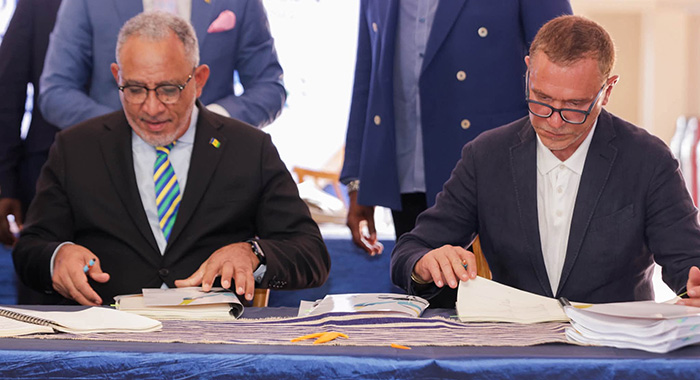
On a Monday official ceremony held in the capital city of Kingstown, the government of St. Vincent and the Grenadines formalized a landmark concession agreement with Global Ports Holding (GPH), the leading global cruise port operator, to oversee the management, large-scale development and long-term operation of the nation’s entire cruise port infrastructure, while retaining full state ownership of all underlying port assets. Government representatives at the signing framed the public-private partnership as a strategic move to elevate the Eastern Caribbean nation’s standing in an increasingly crowded and rapidly evolving global cruise market, with success metrics deliberately designed to extend far beyond simple headcounts of visiting vessels and disembarking passengers. The two-phase development roadmap laid out for the port network targets first an expansion of the existing Kingstown cruise berth, followed by a second phase that adds a brand new cruise pier west of the current Kingstown facility, alongside a dedicated berth for both large cruise ships and mega-yachts located in Clifton on Union Island. Attorney General Louise Mitchell confirmed that the contract mandates non-negotiable minimum capital investments from GPH of no less than US$20 million for the first phase and US$60 million for the second phase, as baseline requirements tied to the agreement’s 30-year exclusive operating term. Beyond direct port construction, policymakers project the expanded cruise ecosystem will unlock cascading economic opportunities for a wide cross-section of local stakeholders, including taxi operators, tour guides, street vendors, local artisans, restaurant owners, small-scale farmers and artisanal fishers who supply goods and services to cruise visitors. Prime Minister Godwin Friday emphasized that the core objective of the initiative is to translate rising cruise foot traffic into stable formal and informal jobs, increased revenue for local small businesses, and tangible improvements in household livelihoods across all communities in the archipelago. Minister of Ports Terence Ollivierre noted that the port network is being designed to function as a national economic platform linked to communities well outside the immediate port zones, and stressed that ongoing, multi-stakeholder collaboration between GPH, government regulators and local industry representatives will be critical to smooth execution as the project moves from planning to ground-breaking. The agreement also includes unprecedented provisions to embed local ownership and protect existing community interests: a dedicated special purpose vehicle will be set up to allow eligible Vincentian citizens to purchase up to 30% of the operating entity’s total issued share capital, with retail individual investors given top priority, and local institutional investors only permitted to access unclaimed shares if retail demand does not exhaust the full 30% allocation. Existing commercial tenants currently operating on port premises are granted guaranteed protection to continue their operations under their original lease terms for a full three years from the official start of GPH’s operations, with further eligibility to renew their leases indefinitely after that period as long as they remain in good standing with no contractual defaults. Senior government officials positioned the cruise port upgrade as a central pillar of a much wider national strategy to rebrand St. Vincent and the Grenadines as a distinct, high-value tourism destination anchored by three core brand pillars: vibrant local culture and festive celebrations, unspoiled marine paradise, and world-class nature and adventure experiences. Supporting parallel work to boost the country’s tourism competitiveness includes ongoing efforts to expand international air connectivity, add more high-quality accommodation inventory, refine global destination marketing campaigns, and upskill local hospitality workforces to raise overall service standards. GPH Founder and Chief Executive Officer Mehmet Kutman reaffirmed his company’s commitment to close collaboration with local government and industry partners, noting that the operator prioritizes the development of immersive, authentic onshore visitor experiences rather than just serving as a docking facility, and highlighted the untapped potential for the wider Caribbean region to capture a larger share of the fast-growing global cruise capacity and surging luxury travel demand. Environmental stewardship was repeatedly cited as a non-negotiable core condition of the entire development framework: both Prime Minister Friday and Tourism Minister Kishore Shallow stated that all tourism expansion work will be required to strictly protect the archipelago’s fragile coastlines, coral reefs, white-sand beaches, marine biodiversity and unique natural heritage, the very assets that draw international visitors to the destination in the first place. Friday also pledged that the government will maintain rigorous, ongoing oversight of every stage of the project’s implementation to ensure the national public interest remains the top priority for the full 30-year term of the agreement.
New deal means bigger cruise port, wider opportunities for SVG — officials