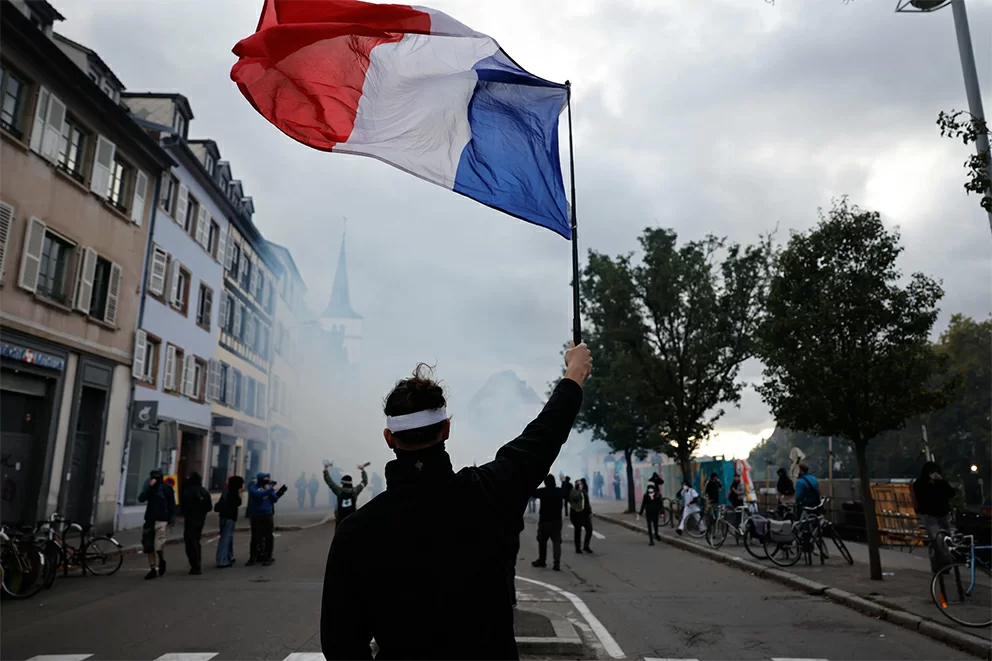
On October 25, official reports confirm that hundreds of thousands of demonstrators took to the streets across French cities on a recent Saturday, voicing demands for improved public education infrastructure, urgent policy interventions to curb soaring living costs, and broader action to reduce widening socioeconomic inequality. The coordinated mobilization, organized by a coalition of major labor unions, student groups, education workers, healthcare staff, and climate activists, marks a sharp escalation of public discontent that first erupted in mid-September when high school students launched strikes to protest dilapidated school facilities, chronic staff shortages, and underfunded learning resources.
The scale of the nationwide unrest has sparked conflicting official estimates: France’s Ministry of the Interior calculated roughly 410,000 total participants across the country, with 110,000 gathering in Paris alone, while leading labor confederation CGT released a far higher figure of nearly 800,000 attendees. Though the marches began largely peaceful, scattered outbreaks of violence marred later stages of demonstrations. In the French capital, clashes erupted after masked protesters threw projectiles at law enforcement, prompting police to deploy tear gas and water cannons to disperse crowds. Similar confrontations were reported in Lyon, Rennes, and other urban centers, where authorities also used tear gas to break up unruly groups.
Ahead of the demonstrations, the French government deployed more than 70,000 police officers and gendarmes across the nation, ramping up security protocols after the previous October 17 protests devolved into widespread looting, property destruction, and arson that left hundreds of businesses and public facilities damaged. Interior Minister Laurent Nuñez confirmed nearly 1,000 total arrests nationwide on the Saturday of the latest marches, with Paris prosecutors separately reporting 64 arrests linked to the capital’s demonstration, 40 of whom were placed in formal police custody. This follows more than 2,000 arrests recorded during the earlier round of violent unrest last week.
Controversy has swirled around government restrictions on protest routes in Paris, where authorities banned the originally agreed central-city march path, forcing the union-led procession to follow a peripheral route from Porte d’Italie to Porte de Vincennes on the capital’s southeastern edge. Several other planned protest assemblies by independent groups were also fully prohibited. Demonstrators and human rights advocates have decried the restrictions as a deliberate attempt by the Macron administration to minimize public visibility of the protest movement, a claim the government rejects, noting the measures were implemented to prevent a repeat of last month’s widespread vandalism. The strict security rules disrupted daily public life across Paris, with shop owners boarding up storefronts, multiple metro stations closed, iconic cultural sites including the Louvre and Musée d’Orsay shuttering for the day, and the Art Basel Paris art fair canceling its full weekend schedule. Multiple other cities including Montpellier, Rouen, and Nice imposed full bans or heavy restrictions on planned protests, while Marseille’s permitted union demonstration was allowed to proceed only under intense police monitoring, with isolated clashes also reported there.
What began as a narrow student-led campaign for better school resources has expanded into a broad cross-society movement that also targets France’s controversial Parcoursup higher education admissions system, which demonstrators argue creates unfair barriers for young people seeking access to further education. In a bid to de-escalate tensions, President Emmanuel Macron met with representatives of the student protest movement for the first time since the unrest began on the Friday before the marches, pledging to hire additional teaching staff and launch a full overhaul of the Parcoursup system. Student representatives have stated the promises are insufficient, and will not pause mobilization until the government releases concrete, actionable policy measures.
The sustained unrest represents a major late-term challenge for Macron, who is constitutionally barred from running for a third consecutive presidential term and will leave the Élysée Palace in 2027, when national presidential elections are scheduled for the spring. The political context of the protests is further complicated by surging public support for the far-right Rassemblement National (RN) party, which has centered its political platform on law enforcement and restoring public order. RN leader Jordan Bardella was re-elected as party chairman on the same day as the nationwide protests, at a party congress in Orléans that drew parallel counter-demonstrations by anti-fascist activists. The protest coalition has already announced plans to continue ongoing mobilization, leaving significant uncertainty over whether the government’s limited concessions can defuse public anger and prevent further violent escalation in the months leading up to the 2027 election cycle.