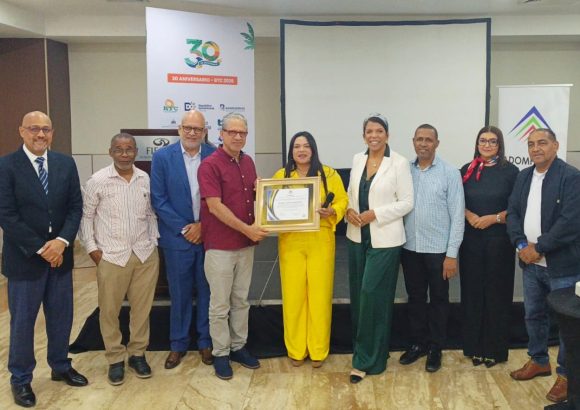
Santo Domingo, Dominican Republic – For decades, the global tourism industry has leaned heavily on polished marketing materials, sweeping aerial footage of unspoiled coastlines, and snappy brand taglines to lure visitors, but the glossy public-facing image of destination marketing often obscures far more nuanced, underreported realities: unequal community benefit, unregulated territorial development, and the growing risk of algorithm-driven misinformation distorting public understanding of travel spaces. To address these gaps head-on, the Dominican Association of Tourism Press (Adompretur) gathered over 100 specialized journalists, regional policy experts, and top hospitality industry leaders at Santo Domingo’s Hotel Dominican Fiesta last Friday for the landmark First International Tourism Journalism Forum, timed to align with the 30th anniversary of the Caribbean Tourism Exchange (BTC).
Operating under the guiding theme “Count, Connect, and Transform”, the event rejected the usual celebratory, industry-focused ceremonial format to confront the shifting, high-stakes responsibilities of travel media in an era flooded by AI-generated content and unvetted algorithmic noise. The morning’s opening keynote from award-winning Argentine travel journalist Fernando Milo set a reflective, action-oriented tone, challenging assembled reporters to move beyond shallow, advertorial-style promotional coverage to craft layered narratives that connect visiting travelers to the often-overlooked social, cultural, and environmental contexts that make destinations distinct, rather than reducing locations to interchangeable leisure backdrops.
That call for deeper, more representative coverage rippled through subsequent panel discussions centered on community-led tourism and sustainable territorial governance. Session participants highlighted successful, locally rooted sustainable development initiatives, including ongoing Japan International Cooperation Agency (JICA) supported projects across the Dominican Republic’s Cibao and Nordeste regions that prioritize preserving local cultural identity, responsible freshwater resource management, and equitable economic inclusion for nearby residents, pushing back against the homogenizing effects of unregulated mass tourism. Additional panels led by industry analysts Milka Hernández and Juan Lladó addressed persistent frictions in the domestic travel sector and gaps in public tourism governance, using lessons from the La Altagracia 2030 Strategic Plan to argue that environmental protection and meaningful community input are non-negotiable prerequisites for long-term, competitive tourism growth, not secondary afterthoughts.
Afternoon sessions shifted focus to the intersection of emerging technology and cross-border regional integration. Digital media expert Guillermo Molina Mueses broke down the dual nature of artificial intelligence for tourism reporting, noting its significant efficiency benefits for processing large datasets to identify industry trends, while emphasizing that unregulated AI use poses severe risks of spreading misinformation that can harm local communities, making rigorous human fact-checking and editorial oversight non-negotiable. A follow-up international panel featuring Mexican tourism analyst Armando de la Garza and Dominican digital strategy specialist Cristina Rosario outlined actionable strategies for travel media to use social and digital platforms to build more genuine, transparent connections with modern, ethically conscious travelers, rather than relying on outdated, overly curated promotional content. The day’s strategic discussions concluded with a forward-looking session on cross-border multi-destination tourism across Latin America and the Caribbean, where veteran tourism sector leaders Luis Felipe Aquino and Manuel Quiterio Cedeño argued that stronger institutional collaboration and jointly developed cross-border travel itineraries, anchored in shared cultural and historical ties, could act as a powerful driver of shared regional economic growth.
The forum’s highest-profile outcome was the unanimous formal adoption of the Santo Domingo Declaration on Tourism Journalism and Communication, a concrete 10-point charter designed to systematically upgrade standards for travel reporting across all of Latin America and the Caribbean. Moving far beyond vague, unenforceable aspirational statements, the manifesto establishes a clear operational framework to reposition tourism journalism from a de facto extension of destination marketing to a rigorous, ethically grounded journalistic discipline. The document enshrines non-negotiable editorial independence, drawing a clear line between impartial public interest reporting and paid sponsored promotional content, while calling for ongoing professional training for tourism journalists in specialized fields including spatial planning, data literacy, and tourism economics. On technological ethics, the declaration explicitly affirms that while AI is a valuable tool for accelerating data processing and supporting investigative reporting, all automated outputs must be subject to full human editorial review, fact verification, and ethical oversight. It also positions environmental stewardship, community-centered tourism, and transparent public governance as core mandatory pillars of travel reporting, urging journalists to amplify coverage of underrepresented emerging local destinations while holding public officials accountable for tourism-related infrastructure spending and environmental management. For regional collaboration, the charter lays out a roadmap for coordinated cross-border reporting and co-developed multi-destination travel narratives that highlight shared cultural heritage across the Caribbean and Latin America. Notably, the text includes a historic call for regional media solidarity, urging all participating news outlets to reject harmful, stereotypical coverage of Haiti, and to support responsible, forward-looking reporting that recognizes Haiti’s viable long-term potential for community-led sustainable tourism once conditions of safety, institutional stability, and robust local community protections are established.