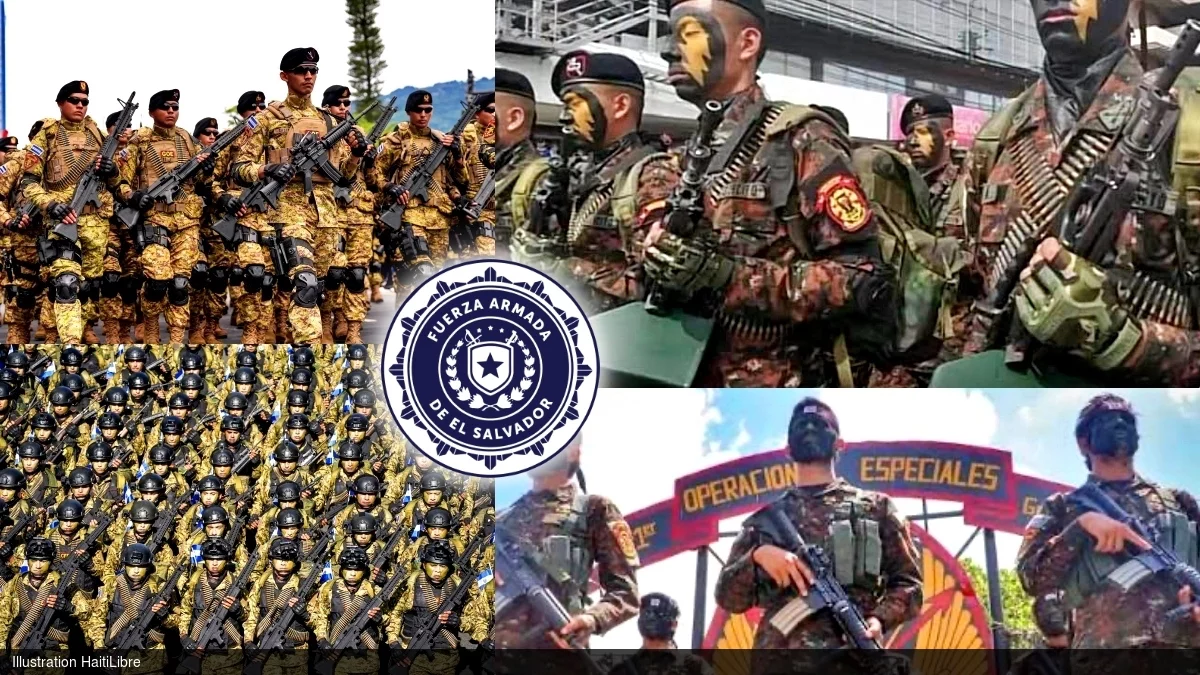
In an unprecedented emergency cross-border military operation, the Government of El Salvador has dispatched a large contingent of its most seasoned special operations personnel to Haiti, following a deadly gang ambush that left four of its service members unaccounted for. The unfolding deployment, first set in motion on October 22, 2026, saw an initial wave of roughly 100 elite commandos touch down at Port-au-Prince’s Toussaint Louverture International Airport to kick off high-stakes search and recovery efforts.
A second major wave of reinforcements arrived the following day, October 23, per verified flight tracking records. A Lockheed Martin C-130J Super Hercules, mobilized by the Pentagon at the formal request of the U.S. State Department, departed El Salvador International Airport at 9:40 a.m. local time and landed in the Haitian capital at 2:07 p.m. carrying an additional 100 combat-ready troops. Over the course of that Friday, air traffic involving both U.S. military and Salvadoran aircraft operating in Haitian airspace intensified sharply, as supply lines were rapidly established to support the mission. Independent on-the-ground sources confirmed the total number of Salvadoran military personnel deployed across Haiti now stands at 450, all positioned to launch targeted offensive operations if required to locate and extract the missing service members.
The deployed force draws heavily from El Salvador’s storied Special Operations Group, a decades-old elite commando formation with specialized training in counter-insurgency and asymmetric urban warfare, augmented by highly refined niche tactical units. Operating autonomously in territory largely controlled by violent Haitian gang networks, the force cannot rely on fragile or untrustworthy local logistics chains to sustain operations, prompting the deployment of a dedicated heavy airlift asset: flight HVY601, operated by a specialized global military cargo carrier. That flight was tasked with delivering the full suite of heavy critical supplies required to keep the contingent fully combat operational, including large stockpiles of ammunition, lightweight tactical mobility vehicles, compact surveillance drones, encrypted anti-interception communications hardware, and comprehensive frontline medical logistics kits.
No official public cargo manifest has been released for security reasons, but operational precedents from past Salvadoran special forces deployments paint a clear picture of the capabilities being brought to bear. The unit is known to deploy swarms of small, lightweight electronic surveillance drones to map gang-held urban zones in real time and identify potential ambush sites before patrols move through high-risk areas. Its personnel also use top-tier encrypted communication systems from leading manufacturers such as Harris to ensure uninterrupted, untapped contact between frontline teams and command headquarters, completely out of the reach of criminal gang surveillance networks. The entire force is outfitted with state-of-the-art night vision and thermal imaging optics, enabling unimpeded search and assault operations even in total darkness.
For direct combat roles, standard issue armament for the contingent includes M4A1, IWI Tavor, and 5.56mm Galil ACE assault rifles, most customized with attached laser aiming modules and suppressors to enable stealth, low-signature movement through populated areas. Sniper teams carry high-precision 7.62mm platforms such as the M24 to secure mission perimeters and eliminate high-value gang targets at long range, while light machine guns including the M249 SAW are deployed to deliver overwhelming suppressive fire if units come under attack. No official confirmation of the exact inventory of armaments and equipment on board the HVY601 cargo flight has been released to the public.
On the afternoon of October 23, El Salvador’s popular president Nayib Bukele addressed widespread public skepticism about the high-risk mission in a lengthy post to his official X account, pushing back against critics who warned the operation was a foolhardy venture destined for catastrophic failure at the hands of Haiti’s heavily armed, long-entrenched criminal gangs. “Thousands of messages, deep dives, and hot takes are circulating right now claiming Haiti’s gangs are nothing like the groups we dismantled at home, that they are uniquely bloodthirsty, impossibly well-armed, and completely unconquerable; that every past similar mission has ended in total defeat; that we are walking straight into a pre-laid trap; that we have no grasp of the threat we are facing; that this operation will spell total ruin for our country, and that we are marching straight toward our own Waterloo,” Bukele wrote.
“Yet the second God grants us victory, those exact same voices will reverse their narrative completely. They will claim the mission was trivial from the start, that any half-competent force could have pulled it off, and that Haitian gangs were never nearly as dangerous as everyone made them out to be. At the end of the day, we have never once tailored our decisions to appease these critics, and we certainly are not going to start now,” he added. Bukele went on to frame the mission in explicitly religious terms, noting “Every single one of our deployed volunteers is a devout believer, and we have placed this entire operation in God’s hands. The gangs terrorizing Haiti are driven by pure, satanic malice, but the Creator of the Universe stands with us, and he will deliver us victory.” He closed his public statement by citing Deuteronomy 28:7: “The Lord will cause your enemies who rise against you to be defeated before you. They shall come out against you one way and flee before you seven ways.”