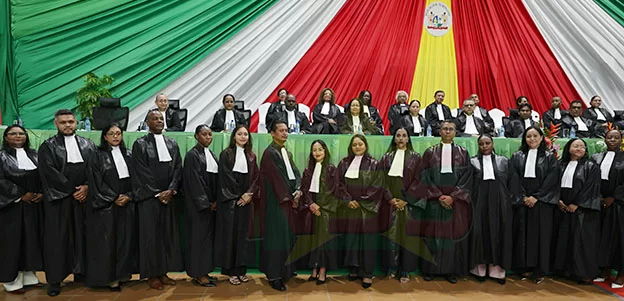
In a landmark institutional shift after 157 years of operation, Suriname’s Court of Justice hosted a formal swearing-in ceremony on October 24 to induct 15 fully trained deputy magistrates, pushing the total number of sitting judges across the national judicial system to 45, the largest cohort in the country’s history. Presiding over the event at the national Congress Hall, Court President Iwan Rasoelbaks framed the unprecedented expansion as a critical pillar of strengthening Suriname’s tripartite separation of powers, following months of collaborative negotiations between the executive branch and the judiciary to secure formal government approval for the appointments. “I can unequivocally confirm that this 50% increase in judicial headcount will drive tangible, measurable improvements in timely case resolution over the coming years, delivering long-overdue relief to communities navigating backlogged court dockets,” Rasoelbaks told assembled guests, including the Minister of Justice and Security.
The 15 new magistrates completed a rigorous, three-year specialized training program developed in close partnership with the Netherlands’ Council for the Judiciary, the country’s Judicial Training Foundation, and cross-border legal experts from both Dutch and Surinamese legal practice. They will begin presiding over independent court sessions starting the Monday following their induction. Rasoelbaks emphasized that their formal training was only a foundational precursor to their public mandate: “The coursework and mentorship you have completed are merely the opening trailer; the full feature film of your judicial service begins today, and you carry full, unshared responsibility for every ruling you issue.” He further stressed that effective judicial service extends far beyond mastery of statutory law, requiring careful attention to procedural fairness, consistent professional conduct, and the ability to communicate complex rulings clearly and accessibly to all parties involved in cases.
Rejecting the outdated framing of the judiciary as a disconnected “ivory tower,” Rasoelbaks urged the new cohort to root their decision-making in the lived realities of Surinamese society, balancing strict adherence to case facts with a broad, empathetic worldview. “A modern judge must operate with the nuance of a diplomat, the contextual awareness of a sociologist and anthropologist, and the emotional insight of a psychologist,” he noted, adding that judges should act as rigorous, impartial analysts committed to equitable outcomes rather than relying on rigid legal literalism, ungrounded moralizing, or overly narrow pragmatic decision-making. Speaking on behalf of the new magistrate cohort, appointee Maytrie Behari affirmed the group’s commitment to upholding full independence, impartiality, and integrity in their roles. “We accept this mandate with profound respect for the weight of the responsibility we carry, and we will work every day to earn the public trust placed in us through consistent displays of wisdom and human-centered judgment,” Behari stated.
Despite the historic expansion, the Court of Justice still faces significant long-term structural staffing challenges. The court’s official strategic target is a total of 60 judges, aligned with the global standard of one judicial officer per 10,000 residents, which leaves a current gap of 15 unfilled positions. While 11 additional trainee judges are set to complete their certification next year, this intake will not be sufficient to offset projected attrition: under the current 70-year retirement age, 17 senior judges are scheduled to retire over the next decade, a figure that would jump to 26 of the 30 current senior judges if the national retirement age is lowered to 65. Rasoelbaks warned that sustained, multi-year investment in extended judicial training and support systems will be required to prevent future staffing shortfalls that could reverse recent progress on case processing speeds. The court has already submitted draft legislative amendments to formalize new governance structures to support the expanded judiciary, including dedicated teams for newly established tax and administrative law divisions, overseen by additional vice presidents, lead coordinators, and specialized team supervisors to streamline case management across civil, criminal, tax, and administrative legal sectors.