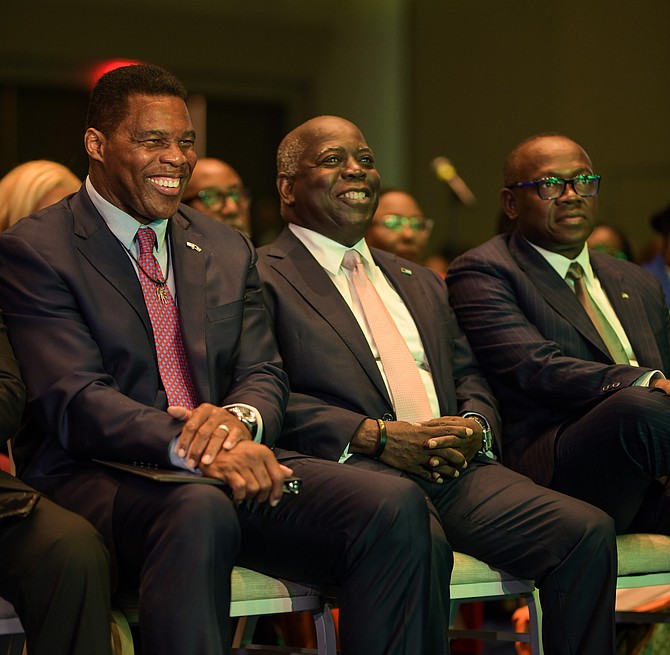
In a formal public statement from Herschel Walker, the United States Ambassador to The Bahamas, the top U.S. diplomatic representative laid out targeted concerns over the Bahamian government’s newly proposed governance overhaul for Grand Bahama, while reaffirming Washington’s longstanding commitment to cross-border partnership on the island.
Since assuming his post in Nassau, Walker noted he had made a core pledge that the U.S. seeks collaborative, mutually beneficial ties with The Bahamas, and that no location underscores that commitment more sharply than Grand Bahama’s Freeport zone. For decades, U.S. firms have maintained operations in Freeport through devastating hurricanes, economic recessions, and prolonged periods of policy ambiguity, and are currently channeling hundreds of millions of dollars into the island’s post-pandemic recovery: ongoing projects include a $120 million redevelopment of the Grand Lucayan resort, the launch of the Celebration Cay community, and the launch of the Western Atlantic University School of Medicine, alongside dozens of other smaller-scale investments.
It is against this backdrop that Walker said he viewed Prime Minister Philip Davis’s recent announcement of a new centralized governance framework for Grand Bahama with significant apprehension. He emphasized that the 1955 Hawksbill Creek Agreement is not an outdated procedural technicality, but the foundational legal pillar that built Freeport: the landmark pact established a 230-square-mile port jurisdiction, assigned operational oversight to the Grand Bahama Port Authority (GBPA), and guaranteed a stable, consistent regulatory environment for global investors in exchange for their upfront capital infusions. For nearly 70 years, that agreement has generated generational employment for thousands of Bahamian residents, while drawing U.S. and international investment to build factories, shipyards, hospitality properties, and residential communities across the island.
The Davis administration’s proposed reform would consolidate all regulatory and licensing authority for the port zone under a single government-led structure, while revising the GBPA’s existing operational mandate. Walker acknowledged that no stakeholders dispute Grand Bahama’s urgent need for improved economic outcomes: for years, U.S. businesses operating on the island have flagged pervasive pain points including overlapping approval processes, undefined fee structures, and glacial administrative decision-making. He noted that Washington fully supports the stated goal of creating a single, transparent administrative process with clearly defined accountability lines.
However, Walker stressed that the process of rolling out these changes is just as critical as the policy’s intended outcomes. While the Bahamian government has launched a dedicated public website, released a detailed green paper, and opened a formal public consultation window, Walker outlined four critical unresolved questions that have left existing and potential investors facing far more uncertainty than clarity: what will happen to pre-existing rights of licensees who originally signed on under the Hawksbill Creek Agreement, including their guaranteed tax and duty exemptions, active licenses, and binding commercial contracts? Who will set regulatory fees moving forward, by what explicit methodology, and what formal appeal processes will be available for operators contesting unexpected charges? What is the concrete, public timeline for implementing the new rules, given that vague “changes coming soon, details to follow” communications represent one of the costliest signals a government can send to global capital allocators? And finally, what formal seats at the decision-making table are being granted to the on-the-ground businesses and local workers who sustain Freeport’s daily operations, before the framework is finalized?
Walker added that these concerns are part of a broader pattern of recent policy shifts that have given global investors pause, including earlier disputes over new overflight fees imposed on U.S. commercial airlines and unexpected retroactive tax demands levied against cruise line operators. While each of these policies appears narrow in isolation, he warned that their cumulative effect sends a worrying signal that rules in The Bahamas can be altered after investors have already sunk large sums of capital into long-term projects – a risk Grand Bahama cannot afford to amplify, given its outsized need for patient, multi-decade investment to drive its recovery.
Walker explicitly clarified that the U.S. is not challenging The Bahamas’ full sovereign right to govern its territory, nor is it seeking special preferential treatment for U.S. firms operating on the islands. Instead, he echoed a call U.S. Secretary of State Marco Rubio made shortly after Prime Minister Davis’s re-election in May, for “transparent and reliable economic and infrastructure partnerships that support sustainable growth.” That standard, Walker outlined, rests on three non-negotiable pillars: first, full honor of all pre-existing legal commitments, so that businesses that invested in good faith under the Hawksbill Creek Agreement retain all the benefits they were originally promised; second, full public release of the complete framework, its underlying legal basis, and a binding implementation timeline before any new rules take effect; and third, meaningful, pre-decision consultation with license holders, international investors, and Grand Bahama’s local workforce, rather than offering them only a chance to provide feedback after policies are already finalized.
The ambassador closed by reaffirming that the U.S. has a direct stake in Grand Bahama’s success: Washington wants to see more U.S. visitors traveling to Freeport, more U.S.-flagged vessels docking in its port, and expanded U.S. investment driving long-term shared prosperity. He noted he has repeatedly told Bahamian government leaders that the U.S. stands ready to deepen collaborative support for the island’s growth, but emphasized that global capital consistently flows to jurisdictions with predictable, stable regulatory rules. With Grand Bahama’s residents having waited years for a sustained economic rebound, Walker urged the Davis administration to structure its new governance framework to accelerate that comeback, rather than introducing unnecessary uncertainty that puts hard-won recovery at risk.
Op-Ed: Grand Bahama needs certainty, not another reset