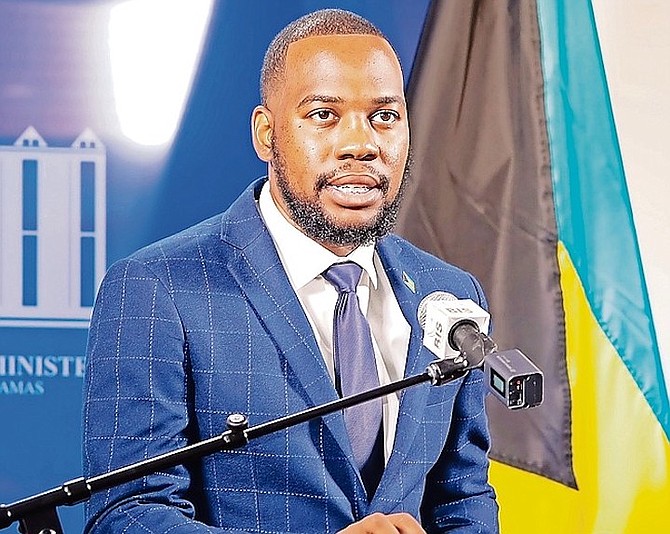
Delivering remarks during a Senate legislative debate on two pending 2026 bills — the Anti-Terrorism (Amendment) Bill and the Companies (Amendment) Bill — the top communications official for the Philip Davis administration pushed back firmly against widespread public assertions that the longstanding diplomatic and economic partnership between The Bahamas and the United States had deteriorated. Senator Rahming, the administration’s chief spokesman, directly challenged all critics making such claims to present concrete verifiable evidence to support their accusations, emphasizing that no active bilateral cooperation programs between the two nations had been suspended or terminated to date.
Rahming framed the unsubstantiated negative narratives circulating about the country’s global reputation and US ties as deliberate partisan political tactics designed to win short-term domestic political points, warning that this deliberate negative framing of the national identity inflicted far deeper, longer-lasting harm than a fleeting 24-hour news cycle. “Political advantage lasts for a season. The good name of the Bahamas must outlast every one of us,” he told the Senate chamber. He underscored that the United States remains The Bahamas’ single largest trading partner, with cross-border collaborative work across law enforcement, trade and public safety continuing uninterrupted on a daily basis.
The public pushback from the administration comes in the wake of two high-profile recent points of friction between Nassau and Washington that have sparked public debate over bilateral relations. First, US Ambassador to The Bahamas Herschel Walker issued a public statement expressing deep concern earlier this week after Prime Minister Davis announced a new policy plan in Freeport that would terminate the Grand Bahama Port Authority’s governing powers under the 1955 Hawksbill Creek Agreement. Second, a month prior, the Bahamian government formally filed a complaint with US Department of Justice officials over unapproved undercover operations run by US Drug Enforcement Administration agents operating on Bahamian soil without prior local government knowledge or authorization, a dispute that emerged from US court filings related to the prosecution of high-profile alleged drug trafficker Jonathan Eric “Player” Gardiner. Ambassador Walker publicly dismissed that formal government complaint as “fake news”, rhetorically questioning why Bahamian officials would object to US efforts to arrest a known major narcotics trafficker.
Opposition Leader Michael Pintard had previously characterized the public diplomatic row as a “dangerous moment” for the small island nation, urging all parties to resolve cross-national disagreements through quiet formal diplomatic channels rather than public statements.
In his Senate address, Rahming acknowledged that close sovereign allies will inevitably hold differing positions on specific issues from time to time, but stressed that these routine disagreements should never be misinterpreted as a sign of a fundamentally fractured or broken bilateral relationship. He noted that national sovereignty grants The Bahamas the full right to articulate its own positions clearly to all nations, both longstanding friends and international actors with opposing interests. He warned that public figures who spread unevidenced claims that The Bahamas is untrustworthy are effectively repeating the same harmful narratives once pushed by the country’s historical international critics, adding that communities that publicly express doubt over their own global standing only invite external actors to adopt that same negative judgment.
He reaffirmed the administration’s full commitment to upholding the rule of law, and stated that ongoing regulatory and legislative processes would be allowed to proceed transparently to their natural conclusion without improper interference. He clarified that The Bahamas has never sought preferential special treatment from the United States or any other partner, but will also firmly reject any unfair or unequal treatment that violates its sovereign rights.
Notably, Ambassador Walker had used nearly identical phrasing in his recent public comments, stating that the United States was not requesting special treatment for its American companies operating in The Bahamas, but was instead asking the Bahamian government to uphold its existing binding commitments to Freeport-based investors, release full public details of its regulatory reform framework, and conduct meaningful stakeholder consultation before finalizing any major policy changes.
Prime Minister Davis had previously clarified that the planned Freeport governance reforms will be implemented fully through lawful parliamentary processes, will not apply retroactively, and will systematically identify, document and protect all legally established rights of existing licensees, with a formal public consultation period for the policy running from November 1 through April 30, 2027. On the DEA operation dispute, Davis had previously stated that his administration has no objection to law enforcement agents targeting transnational criminal actors, but that all cross-border law enforcement activities must follow established formal bilateral protocols, and urged the Bahamian public earlier this month to take the US ambassador’s advice and wait for formal processes to conclude before drawing final judgments.