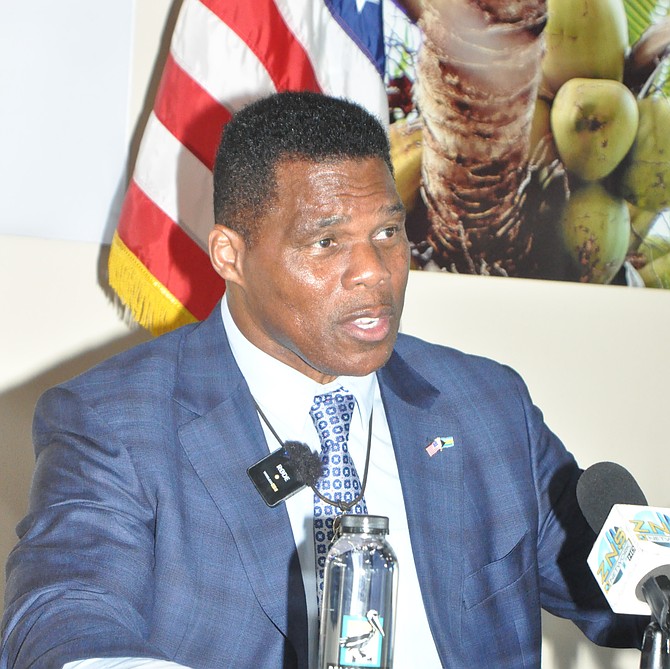
In a high-profile, unprecedented public intervention, United States Ambassador to The Bahamas Herschel Walker has openly criticized the Philip Davis administration for purportedly conveying to global investors that regulatory rules in the Caribbean nation can be altered after capital is already deployed, amid the government’s proposed takeover of Freeport’s governing authority from the longstanding Grand Bahama Port Authority. Walker’s remarks were published in a formal op-ed just 24 hours after Prime Minister Philip Davis publicly unveiled his sweeping reform framework for Grand Bahama, marking the second time in a single month the senior US diplomat has directly challenged the Bahamian administration’s policy moves. The prior public clash erupted weeks earlier when Walker dismissed the Bahamian government’s official complaint that undercover US Drug Enforcement Administration agents had operated on local soil without prior approval as “fake news”.
In his latest commentary, Walker emphasized that he had reviewed Davis’s newly announced governance restructuring for Grand Bahama with profound apprehension, grouping the Freeport regulatory overhaul alongside two other recent policy moves: newly implemented overflight fees levied on American commercial airlines, and updated tax requirements imposed on cruise line operators, both of which he had already flagged to Bahamian officials earlier this year. He noted that while each individual policy appears narrow and isolated on its own, their cumulative effect sends a unified, discouraging signal to global investors at a moment when Grand Bahama is in desperate need of sustained, long-term patient capital to drive its post-pandemic and post-hurricane economic recovery. “The message that ‘changes are coming, details to follow’ is the single most costly signal any government can send to entities evaluating cross-border investment locations,” Walker stressed, adding that the people of Grand Bahama have waited far too long for the island’s economic resurgence, and he is urging the Davis administration to ensure the new governance framework accelerates that comeback rather than endangering it.
Prime Minister Davis first unveiled the reform plan during a Wednesday evening address hosted at the Grand Bahama Shipyard, where his administration released a formal Green Paper outlining a multi-year roadmap for the island’s future. He declared that the decades-old model governing Freeport would be fully terminated, and that the path to reform is no longer open to negotiation. The existing 1955 Hawksbill Creek Agreement, set to remain in effect until 2054, granted the privately run Grand Bahama Port Authority exclusive authority over business licensing, construction permitting, and land use planning across the entire port zone in exchange for broad tax exemptions for operators. Davis has repeatedly characterized the decades-old arrangement as a colonial-era relic that has long outlived its utility and no longer serves the public interest of Bahamian citizens.
Walker pushed back on framing the original agreement as a trivial technicality, noting that generations of local Bahamians secured stable formal employment precisely because international businesses trusted the binding, long-term stability of the contractual commitments embedded in the deal. He pointed out that thousands of US and global investors poured capital into building factories, shipyards, luxury resorts, and residential communities on Grand Bahama explicitly based on the predictable regulatory framework the Hawksbill Creek Agreement guaranteed. The ambassador laid out three clear, non-negotiable requests for the Bahamian government: first, that all businesses that made investment decisions in good faith under the original agreement must retain every benefit and guarantee they were originally promised; second, that the full detailed regulatory framework, its underlying legal basis, and a concrete implementation timeline must be published publicly before any new rules take effect; and third, that existing license holders, international investors, and Grand Bahama’s local workforce must be included in formal consultation processes immediately, rather than being brought in after policy changes are already finalized. He noted that at present, investors have far more unanswered questions than clarity, including whether their existing tax and duty exemptions, active business licenses, and signed contracts will be fully honored, which government body will set new fees, what formal appeal processes will be available, and a definitive timeline for all reforms. Walker explicitly clarified that the United States is not challenging The Bahamas’ sovereign right to govern Grand Bahama, nor is it requesting preferential, special treatment for American companies operating on the island.
The ambassador acknowledged that no party disputes Grand Bahama’s urgent need for improved economic outcomes, noting that American businesses have for years raised complaints about overlapping approval processes, ambiguous fee structures, and slow bureaucratic decision-making. He added that the United States would fully support a streamlined, transparent regulatory system with a single clear point of accountability, praising the Bahamian government’s new official website, the content of its Green Paper, and its planned public consultation period as positive first steps. Walker also highlighted the scale of existing US investment in Grand Bahama’s ongoing recovery, including the $120 million redevelopment of the Grand Lucayan resort, Carnival’s $500 million Celebration Key cruise port, and the Western Atlantic University School of Medicine, emphasizing that global investors consistently direct their capital to jurisdictions with stable, predictable rules.
Prime Minister Davis responded to the concerns by committing that all reforms will be implemented lawfully through the Bahamian Parliament, with no retroactive changes applied to existing agreements, and that all legally valid rights held by current license holders will be formally documented and fully respected. He noted that the strongest possible incentive a government can offer to foreign investors is clear, rock-solid certainty, and framed the entire reform initiative as a core matter of national sovereignty, referencing his address at the United Nations General Assembly the prior month where he reaffirmed The Bahamas’ full sovereign authority, asking rhetorically what value national independence holds if it stops at the boundary of the Freeport port zone.
The Green Paper lays out a detailed, multi-year implementation timeline: public consultations will run from November 1, 2024 through April 30, 2027, including a series of town hall meetings across Grand Bahama and opportunities for formal written public submissions. The government is required to publish a full audit of all existing responsibilities currently held by different parties by January 31, 2027, release a formal White Paper outlining final policy positions by July 1, 2027, and table draft legislation in Parliament by December 31, 2027, with a target of passing the final law in the first quarter of 2028. Davis extended a formal invitation to the Grand Bahama Port Authority, its shareholders, existing license holders, and all port employees to participate fully in the consultation process.
For its part, the Grand Bahama Port Authority released a public statement noting that all its existing contractual rights, as well as the rights of all its licensees, must be fully respected, and can only be modified through mutual negotiated agreement, adding that the majority of the reform measures Davis announced had not been shared with the authority in advance of the public address.
The earlier diplomatic dispute over DEA operations arose after the Bahamian government formally notified the US Department of Justice that undercover DEA agents had conducted operations on Bahamian territory without prior official authorization, as part of an investigation targeting high-profile alleged drug trafficker Jonathan “Player” Gardiner. At the time, Walker publicly expressed bewilderment, asking “Bahamian officials are concerned that the United States helped to arrest a known drug trafficker?” before later emphasizing that the US can no longer accept the unregulated flow of illegal narcotics across its borders, and urging the Bahamian government to collaborate closely with its closest ally. Bahamian Attorney General Wayne Munroe responded by noting that foreign agents conducting activities that would normally qualify as drug trafficking offenses under local law could face criminal prosecution if they did not receive prior official approval, while Davis framed the dispute as a procedural question about standard protocols for cross-border law enforcement cooperation, adding that his administration would consider the ambassador’s guidance and urged the public to “wait and see” how the situation unfolds.
Opposition Leader Michael Pintard characterized the ongoing public diplomatic row as a “dangerous moment” for The Bahamas, noting that such high-stakes disagreements between close allied nations should be resolved through quiet, behind-the-scenes diplomatic channels rather than public posturing. He also raised questions in the House of Assembly last week, demanding formal clarification on whether Davis endorsed recent public remarks made by The Bahamas’ ambassador to Washington, Wendall Jones, and requesting that the opposition be fully briefed on all points of conflict with the United States government. The tensions come on the heels of a separate advisory issued by the US Embassy in June, which barred all American government employees from renting jet skis or participating in unregulated water sports in The Bahamas, citing a string of recent fatalities, serious injuries, and reported sexual assaults. Walker had urged the Bahamian government to strictly enforce its existing water sports safety regulations at the time, a move that local water sports operators warned could lead to a 40 percent collapse in their annual revenue. Walker made his first official visit to Grand Bahama back in June, where he stated he was “shocked” that the island had not attracted a far larger share of American investment, and pledged to serve as a dedicated advocate for Grand Bahama’s economic development in meetings with Bahamian officials based in New Providence. He closed his op-ed with a clear statement of collaborative intent: “The United States wants Grand Bahama to succeed. I have told Bahamian leaders many times that we are ready to do more to support that goal.”