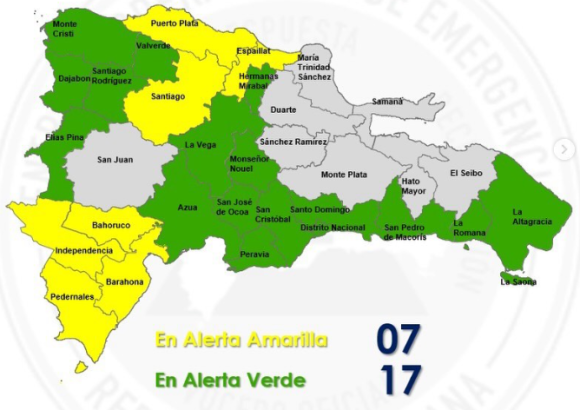
Authorities in the Dominican Republic have rolled out a multi-level national weather alert system, placing seven provinces on yellow alert and 17 additional jurisdictions — including the capital’s National District — on green alert, as forecasters warn of imminent heavy rainfall, severe thunderstorms and powerful wind gusts across much of the country.
The country’s Emergency Operations Center (COE) announced the alert levels following a formal warning from the Dominican Institute of Meteorology (INDOMET), which linked the impending severe weather to a combination of a low-pressure trough spanning multiple atmospheric layers and a warm, moisture-saturated air mass moving across the region. Meteorologists note these conditions will drive rapid cloud formation and bring precipitation ranging from steady heavy downpours to locally intense storm bursts. Along with rain, the system is expected to bring thunderstorm activity, a risk of small hail, and sudden strong wind gusts that could create hazards for residents and infrastructure.
Officials have warned these wind gusts may snap tree branches and cause structural damage to already compromised buildings, posing a serious safety threat to communities in affected areas. The worst of the storm activity is projected to first impact the country’s southwestern region, border communities, Caribbean coastal zones and eastern plains, before gradually spreading across the rest of the Dominican Republic over the coming hours.
The seven provinces placed under yellow alert, the second-highest alert level signaling elevated risk, are Puerto Plata, Pedernales, Independencia, Bahoruco, Barahona, Espaillat and Santiago. Green alert, a lower-level advisory calling for preparedness, covers the National District, Greater Santo Domingo, San Cristóbal, Monseñor Nouel, La Vega, San Pedro de Macorís, Dajabón, San José de Ocoa, Valverde, La Romana, Azua, Peravia, La Altagracia, Santiago Rodríguez, Elías Piña, Hermanas Mirabal and Monte Cristi.
In a public advisory, COE has issued clear safety guidance for residents across all alerted regions. The agency urged people to avoid crossing swollen rivers, creeks and steep ravines where water levels are rising rapidly, and warned against recreating at public swimming areas and coastal recreation zones while the alerts remain in effect, to reduce the risk of flash flooding or water-related accidents.