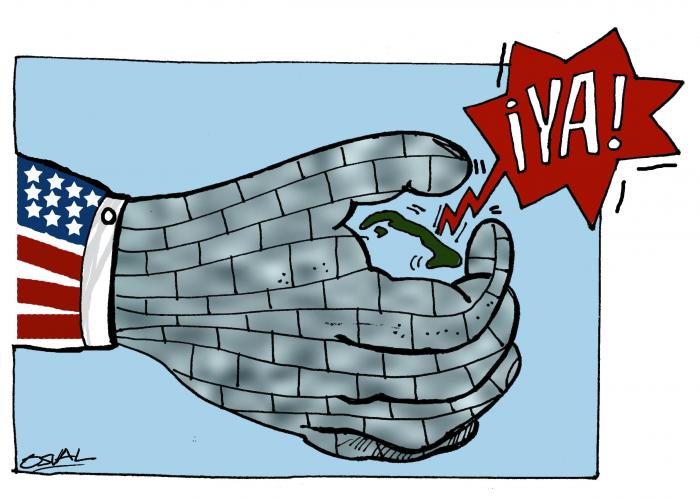
As the United Nations General Assembly prepares to vote on a resolution calling for an end to the U.S. embargo against Cuba, the Caribbean island nation once again brings its decades-long struggle under an unrelenting economic siege to the global stage. Cuban officials and citizens alike argue that the word ‘blockade’ no longer fully captures the suffocating, all-encompassing pressure that has shaped daily life on the island for generations.
This year’s vote marks decades of overwhelming international consensus in support of Cuba’s call to lift the inhumane policy. Last year alone, 185 UN member states backed the resolution, with 165 voting explicitly in favor of ending the U.S.’s economic, commercial and financial restrictions on the island. Yet the United States, deaf to the collective will of the global community, has only doubled down on its pressure campaign, threatening third-party nations and enforcing a regime of collective punishment that falls disproportionately on ordinary Cuban people.
The latest damage assessment from Cuba’s Ministry of Foreign Affairs lays bare the staggering human and economic toll of the policy. Between March 2025 and February 2026 alone, the blockade caused $8.083 billion in direct losses, a 7% year-over-year increase that marks a new record for annual damage. Cumulatively, the policy has cost Cuba more than $178.7 billion in adjusted losses over its nearly 70-year history. Beyond the raw numbers, the blockade drives up the cost of critical imports including medical equipment, life-saving pharmaceuticals, and educational technology, while cutting off the island from global access to affordable financing. Cuban Foreign Minister estimates that without the blockade, Cuba’s 2025 GDP would have been 10.8% higher than the current official figure.
These statistics hide a granular, daily hardship that touches every Cuban household. The energy blockade, intensified by Washington to unprecedented levels, is not an abstract political talking point: it is a mother forced to cook with firewood because household gas is unavailable, an elderly resident climbing 10 flights of stairs on foot because a broken elevator cannot be repaired, and a teenager finishing homework by candlelight or the dim glow of a dying mobile phone battery when grid power fails.
Nowhere is the cruelty of the blockade more visible than in Cuba’s world-renowned public healthcare system. Restrictions block the delivery of fuel for ambulances, diagnostic reagents for medical laboratories, and essential medications for community pharmacies. One devastating outcome: Cuba’s infant mortality rate, a metric the country kept at among the lowest in the region for decades through its free, universal public system, has doubled in recent years amid restricted access to supplies. These are preventable deaths, unnecessary grief for families, and futures cut short by the deliberate policy of a global power that has refused to accept Cuba’s 1959 choice of sovereign self-determination.
Veteran Swiss oncologist Franco Cavalli, who has worked alongside the Cuban healthcare system for five decades, has labeled the blockade what it is: an attempted genocide, a deliberate strategy to break the Cuban people through deprivation of basic needs and access to healthcare. This is no overheated rhetoric, but a clear description of a policy designed to force political change through suffering. Even now, thousands of containers holding desperately needed medical supplies are stuck or diverted at ports across the globe, as shipping lines and financial institutions avoid any interaction with Cuba for fear of harsh U.S. retaliation.
Critics of the Cuban government, including U.S. officials, often argue that Cuba’s domestic hardships stem from the island’s own policy choices, not the blockade. Cuban observers push back with a simple logical question: if that were true, why would the U.S. refuse to lift the embargo? If the policy serves no purpose, removing it would do nothing to change outcomes for Cuban people — but the U.S. continues to strengthen restrictions instead.
For nearly 70 years, this coercive strategy has failed to break Cuba’s unwavering resilience, despite attempts to force the island into submission through hunger and economic despair. The U.S. has even stepped up pressure on other UN member states to reverse their support for the end of the blockade this year, a frantic lobbying campaign that Cuban officials say only highlights the U.S.’s growing moral isolation on the world stage.
Through all of this hardship, Cuba has maintained its dignity and its commitment to sovereign self-determination. Today, the words of Cuban independence icon José Martí, written in his 1891 essay Our America, carry new weight: Martí warned of the ‘seven-league giant’ that sought to dominate the nations of the Americas, and called on independent peoples to stand against foreign interference.
Cuba remains open to a future of mutual respect and dialogue with the United States and the global community. The island has never imposed unilateral sanctions on other nations, nor has it closed the door to cooperative engagement. Cuba says it is ready to meet any gesture of rapprochement with good faith, as long as any talks are rooted in respect for Cuban sovereignty and the right of the Cuban people to determine their own political and economic future, without external conditions or demands.
Until that day of lifting the siege comes, Cuba will continue to stand tall. The country remains hopeful that the overwhelming majority of the global community will once again voice their support for ending the blockade at the UN General Assembly. For Cuba, this vote is more than a symbolic gesture: it is a global rebuke of a policy that has inflicted unnecessary suffering on the Cuban people for nearly 70 years, and a reminder that the world stands with the right of small nations to exist free of foreign coercion.