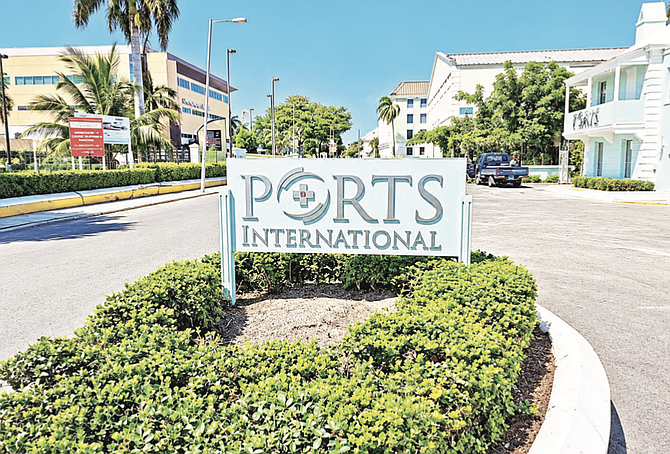
A years-long dispute over the final wishes of a prominent Bahamian business leader has reached a landmark ruling from the Supreme Court of the Bahamas, where Justice Hope Strachan has rejected two estate executors’ attempt to invalidate half a million dollars in charitable bequests left by the late Mary Carolyn Papai, founder of leading regional medical supplier Ports International.
Papai, who launched Ports International in 1987 – a firm that now imports and distributes medical, surgical, pharmaceutical and public safety supplies counting the Bahamian Ministry of Health and Public Hospitals Authority among its core clients – finalised her will in February 2014, just eight months before her death that October. Her will outlined a series of targeted charitable gifts: $300,000 for New Providence Community Church, earmarked in part for a columbarium where Papai requested her ashes be interred; $50,000 for the Cancer Society of the Bahamas; and a $150,000 trust fund for three nonprofits: Smile Train, World Vision, and Youth Empowerment through Soccer. All gifts shared one common clause: they were to be drawn first from Papai’s personal bank accounts and second from corporate accounts held by Ports International.
After the Supreme Court granted probate to Papai’s chosen executors, Ronald Harcourt Knowles and Charles Wenzel Mackay, in August 2015, the pair refused to disburse any of the charitable funds for nearly seven years. Their core argument centered on two claims: first, that Papai held no active personal accounts at the time of her death, and second, that corporate funds held by Ports International could not legally be gifted by Papai as an individual shareholder, since the company’s assets are legally separate from those of its owners. The executors further justified their refusal by claiming the church had failed to provide detailed cost breakdowns for the proposed columbarium and information about other planned donations to the project, leading New Providence Community Church to file a formal lawsuit against the estate in October 2022. The church also accused the executors of mismanaging the estate to prioritize Papai’s son, who was named the residual beneficiary of all remaining assets including Papai’s full shareholdings in Ports International and HMH Enterprises Ltd, and her private properties in Sandyport.
In her 20 October ruling, Justice Strachan carefully balanced competing legal claims to deliver a nuanced decision. She agreed with the executors on one key point: corporate assets held by Ports International are not the personal property of Papai as a shareholder, and the executors were correct to refuse to withdraw company funds to cover the bequests. But she rejected their leap to conclude the entire gifts were therefore void. Clarifying a core principle of inheritance law, Strachan classified the charitable donations as demonstrative legacies – fixed-sum gifts that name a preferred source for payment, but do not fail if that source cannot be used. Instead, any shortfall is simply covered by other remaining assets in the estate. “A failed source does not necessarily mean a failed gift,” Strachan wrote in her ruling, illustrating the distinction with two common examples: while a specific gift of a unique item such as a gold watch becomes void if the item no longer exists at the time of death, a fixed cash gift earmarked to come from a specific bank account remains valid even if that account holds less than the promised amount, with the balance drawn from other estate holdings.
Strachan also rejected the executors’ additional conditions for payment, noting that Papai’s will included no such requirements for the church to provide columbarium cost or donor details. “The court could not invent a condition simply because it might explain why Papai wanted to benefit the church,” she wrote.
The justice further pushed back on the executors’ claim that Papai held no personal accounts at the time of her death, pointing to contradictory entries in the original probate declaration that listed $49,153.24 in a Scotiabank account and $820.31 in a Royal Bank of Canada account, alongside a listed total estate value of $96,067. Strachan ordered the executors to file a full, itemized inventory and accounting of all estate assets, receipts, debts, and expenses within 45 days, including a reconciliation of the minor discrepancy between listed asset values and the stated total estate value, full disclosure of any dividends or distributions the estate received from Ports International or HMH Enterprises, and a full accounting of any transfers or payments made to Papai’s son. She also ruled that the estate must disclose all dividends or other payments it has received from the two companies.
The ruling does not guarantee the full $500,000 will be disbursed immediately or in full. Strachan rejected the church’s request for an immediate payout of the full $300,000, noting that the face value of a bequest does not guarantee the estate has sufficient liquid assets to cover it in full. Once the full estate accounting is filed, the court will determine how much can be covered by the originally named sources, apply the statutory order of asset distribution, and decide if any reductions to the charitable gifts are required. While Strachan declined to order an immediate sale of the Sandyport properties or shares left to Papai’s son, she noted that those assets would not be protected from sale if the estate ultimately requires liquidation to cover the bequests.
Additional questions including whether the executors breached their fiduciary duties, whether Papai’s son received improper preferential treatment, and whether the executors can be held personally liable for any losses will be decided at a later hearing. Strachan noted that a misinterpretation of will language does not automatically make executors personally liable, and she found no evidence of fraud, dishonesty, bad faith or intentional misconduct in the case. The court awarded the church its legal costs for the core question of the validity of its bequest, while the church’s claim for unpaid interest will be addressed once the final amount owed and payment date are determined.
Norwood Rolle represented New Providence Community Church in the proceedings, while Owen Wells acted as legal counsel for the two executors.