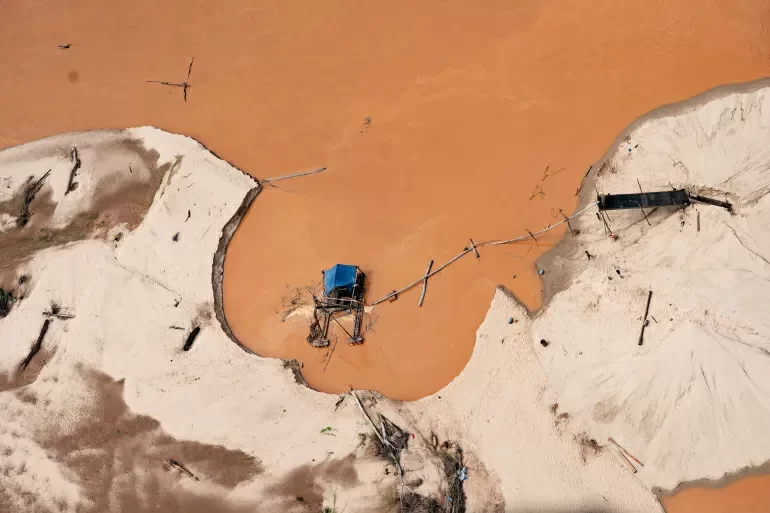
On Monday, October 19, a deadly collapse at an unregulated illegal gold mine in southwestern Colombia left at least 14 miners dead and seven others injured, marking the second major fatal mining disaster to hit the region in just three months. Rescue operations at the site have now concluded, but Colombian disaster management officials confirm that an additional 12 to 15 miners remain unaccounted for, with no confirmation yet on whether they are still trapped beneath rubble.
The accident occurred in the rural Chambero district of Santa Bárbara de Iscuandé, a municipality located in Colombia’s southwestern Nariño Department. Situated deep within dense rainforest, the remote site is only accessible by small aircraft or boat, and challenging terrain combined with spotty communication has significantly hampered emergency response efforts.
Nariño Governor Luis Alfonso Escobar has confirmed the operation was an informal, unlicensed mining venture. In the wake of the tragedy, he called on Colombia’s national government, national mining agency, and Ministry of Mines and Energy to accelerate formalization efforts for small-scale and informal mining operations, a step designed to enforce stronger safety standards and improve dangerous working conditions across the sector.
This collapse is the second major deadly mining accident to hit Nariño in less than three months. Back in August, a slope failure at another illegal gold mine in the municipality of Policarpa killed 13 people and injured seven more. Local authorities later determined that collapse was likely caused by improper extraction techniques that gradually weakened the mine’s structural foundation until it failed.
The October 19 disaster is far from an isolated incident for Colombia’s troubled mining sector. Earlier this year in May, an explosion at the La Ciscuda coal mine, a licensed operation in the Cundinamarca department municipality of Sutatausa, killed nine workers and left six others rescued. The string of accidents underscores the systemic safety risks plaguing Colombia’s mining industry, with unregulated operations particularly lacking basic safety infrastructure and consistent government oversight. While working conditions vary drastically between individual sites, collapses and explosions can result in mass casualties when incidents occur.
Beyond Colombia’s borders, unregulated illegal gold mining has emerged as a widespread, multifaceted crisis across the broader Latin American region. In the Amazon basin, which spans parts of Peru, Brazil, and Venezuela, illegal mining activities drive widespread deforestation, contaminate water and soil with mercury and other toxic pollutants, and fuel violent territorial conflicts between criminal groups vying for control of rich mineral deposits.
In recent months, Peruvian authorities have ramped up enforcement campaigns targeting illegal gold mining in the Madre de Dios region, dismantling mining installations and seizing equipment operating within protected Amazon conservation areas. These operations focus primarily on curbing environmental damage and stopping unlicensed exploitation, though they have not addressed the repeated safety failures that lead to collapse deaths in informal mining sites.
Illegal mining in Peru is also tied to rising violent criminal activity. In January, three informal miners were shot and killed in an attack in the Pataz mining region, and in May 2024, 13 mining company employees and security personnel were killed after being abducted in the same province. Both incidents were tied to organized criminal conflict over mining territory, not accidental mine collapses.
Taken together, these repeated tragedies and incidents across the region highlight that informal and illegal mining in Latin America creates overlapping crises: it endangers the lives of workers through unregulated practices, causes irreversible damage to critical ecosystems like the Amazon, and is deeply intertwined with the operations of transnational and local organized criminal networks.
As of Tuesday, Nariño authorities have not released a complete count of how many workers were present in the mine at the time of the collapse, nor is it yet clear how many of the missing people will ultimately be confirmed as fatalities.