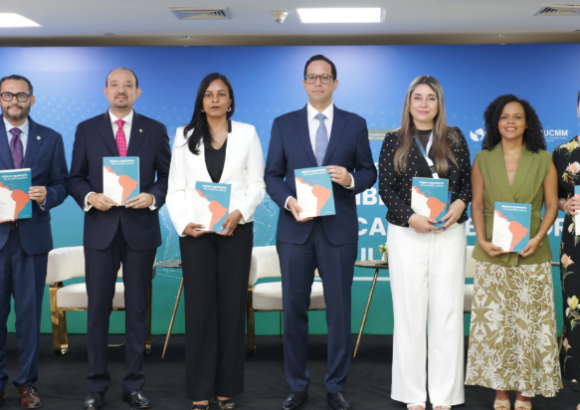
In a key institutional transition following the 15th Ordinary Meeting of the Ibero-American and Caribbean Network for Regulatory Improvement, the Dominican Republic has formally passed the torch of general coordination to Peruvian authorities, closing out a one-year term leading the cross-border governance organization. The gathering, which assembled delegates and policy leaders from more than 20 nations across the region, unfolded over two days at the Pontificia Universidad Católica Madre y Maestra (PUCMM) in Santo Domingo, with technical and logistical backing from two major global development bodies: the Inter-American Development Bank (IDB) and the Organisation for Economic Co-operation and Development (OECD).
The formal transfer ceremony was led by Sigmund Freund, Dominican Republic’s Minister of Public Administration, who handed over coordination responsibilities to Jorge Luis Reyes de Castro Mesa, Secretary of Public Management for Peru’s Presidency of the Council of Ministers. In his remarks at the event, Freund expressed gratitude to all member states for the trust placed in the Dominican Republic’s leadership over the preceding 12 months, and emphasized his confidence that Peruvian leadership would advance the network’s core mission of streamlined, effective regulation across the region.
During working sessions, meeting participants delved into four central themes that have emerged as top priorities for public administration across Latin America and the Caribbean: enhancing regulatory quality, advancing administrative simplification to reduce bureaucratic red tape, integrating artificial intelligence into public governance processes, and strengthening institutional capacity across national governments. A diverse lineup of attendees included senior officials from the OECD and IDB, alongside delegations from major regional economies including Chile, Mexico, Bolivia, Colombia and Brazil, alongside local Dominican policymakers.
As part of the Dominican Republic’s formal reporting on its coordinating term, Freund presented the country’s national chapter in the new edited volume *Regulatory Improvement in Latin America*. The contribution detailed the significant progress the Dominican Republic has made in regulatory reform following the passage of Law 167-21 on Regulatory Improvement and Simplification of Procedures. Freund explained that the landmark legislation established formal governance frameworks and standardized procedures for the development, publication, and periodic review of national regulations. The law was later updated to further streamline processes, cutting unnecessary red tape for both public sector institutions and ordinary citizens accessing government services. Dominican delegates also contributed to broader panel discussions focused on administrative simplification, regulatory quality standards, and the expansion of digital government initiatives across the region.