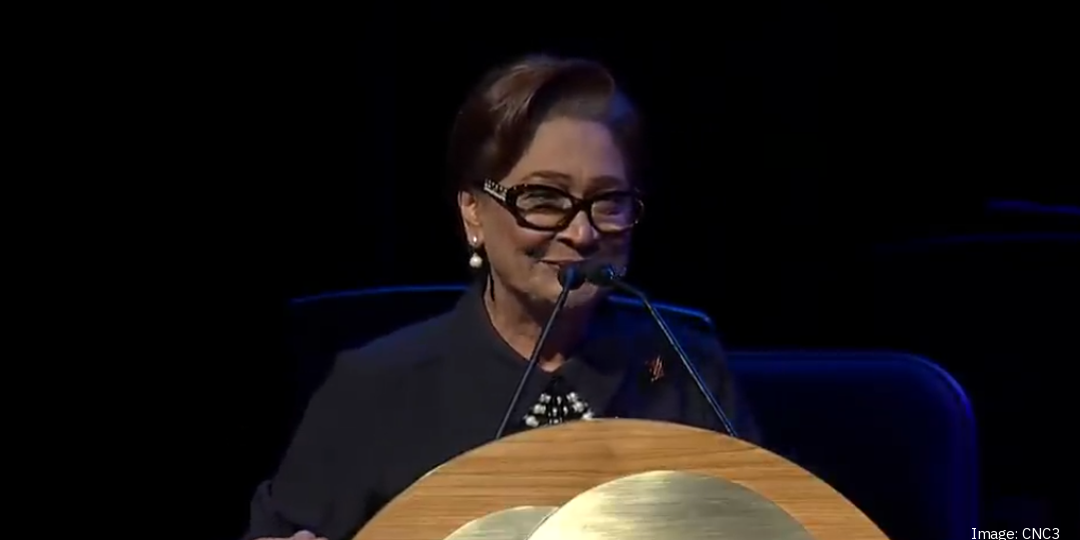
The recent farewell ceremony for legendary calypsonian The Mighty Sparrow, born Francisco Slinger, was dominated by Mia Mottley’s headline-grabbing proposal to add lessons on Caribbean slavery to the Caribbean Examinations Council (CXC) curriculum. However, another equally important set of commitments came from Prime Minister Kamla Persad-Bissessar, whose remarks deserve closer scrutiny beyond the initial headlines.
Persad-Bissessar opened her tribute with a lighthearted shared joke with Mottley – that neither woman would have ever found success as a professional singer – before launching into a thoughtfully structured eulogy for Sparrow. She celebrated him as a cultural icon, regional ambassador, master storyteller, and incisive social commentator, then delivered a striking remark that captures the core of calypso’s cultural role: she described the genre as “our newspaper, our parliament, our theatre, our comedy, our protest, and our history book.”
This acknowledgment that the ‘real parliament’ of Caribbean public discourse often sat in the humble calypso tent is a rare and meaningful concession from a head of government. Far from diminishing the role of formal political institutions, the comment honors both spaces: for generations, calypsonians like Sparrow have shaped how Caribbean people understand their national identity and collective experience, turning complex social issues into accessible, memorable narratives.
Turning to education, a topic of longstanding personal importance to her, Persad-Bissessar shared her own childhood connection to Sparrow’s work: growing up near her mother’s roti shop, which had a jukebox constantly playing Sparrow’s calypsos, many of which carried clear messages encouraging children to prioritize education. Echoing the core of Sparrow’s messaging, she emphasized that “education gives our children the power to change their circumstances” and noted that Sparrow’s ability to frame national dialogue in language accessible to all allowed his words to travel “from the calypso tent into the classroom and into the home.” This framing makes her support for Mottley’s proposal all the more meaningful, coming as it does from the leader of a government now tasked with advancing the plan.
Persad-Bissessar also highlighted a defining quality of Sparrow’s international appeal that resonates across the entire Caribbean region: “He never had to become less Caribbean in order to become international.” She recalled that during her first tenure as Prime Minister, she oversaw the conferral of the Order of the Republic of Trinidad and Tobago, one of the many high honors bestowed on Sparrow over his decades-long career.
By the end of her tribute, Persad-Bissessar put forward two concrete commitments to honor Sparrow’s legacy. First, she confirmed that the government of Trinidad and Tobago would partner with Mottley and other CARICOM member states to turn Mottley’s CXC syllabus proposal into a reality. Second, she announced that the iconic Grand Stand at Port of Spain’s Queen’s Park Savannah – the historic open-air central hub of Trinidad and Tobago Carnival – would be renovated and renamed in honor of Dr. Slinger Francisco, The Mighty Sparrow. It is a fitting tribute for an artist who brought Caribbean Carnival music to a global audience.
While both pledges represent meaningful steps to honor Sparrow’s legacy, neither came with a timeline, assigned responsibility, or allocated budget. This omission is understandable, given that a funeral is first and foremost a moment of commemoration and sentiment, and the commitments themselves are undeniably worthy. However, for these pledges to move from announcement to action, clear next steps are needed.
As founder and publisher of Caribbean Bridges, Julian Rogers outlines three clear calls to action for Persad-Bissessar’s government. First, assign a lead ministry to oversee the CXC curriculum proposal and formally add it to the agenda of the upcoming CARICOM Heads of Government meeting, co-sponsored by Trinidad and Tobago and Barbados under Mottley’s leadership. Second, publish a clear timetable and cost breakdown for the Grand Stand renovation, including whether the project will be completed in time for the February Carnival season. Third, tie both initiatives together: the renamed Grand Stand will be a visible landmark for Carnival attendees, but a comprehensive educational package including licensed recordings, contextual historical materials, and lesson plans will bring Sparrow’s legacy to every child across the region, and revenue from the landmark project could be used to fund the educational initiative.
Persad-Bissessar closed her tribute with the fitting observation: “The king has left the stage, but the song goes on.” Songs do not sustain themselves through memory alone. They require intentional preservation through educational institutions, public archives, and committed government resourcing to ensure future generations can engage with Sparrow’s extraordinary legacy.