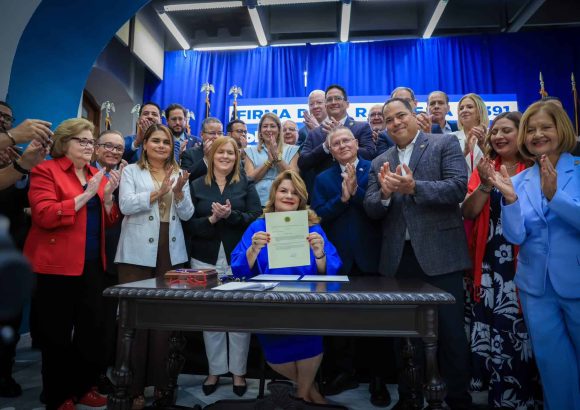
On a landmark Friday for Puerto Rico’s decades-long political status debate, Governor Jenniffer Gonzalez enacted a historic joint resolution that formally submits an official request to U.S. President Donald Trump and the U.S. Congress to admit Puerto Rico as the 51st state of the American Union, granting it the same full rights and standing as all existing U.S. states.
Gonzalez, who leads the pro-statehood New Progressive Party (NPP), framed the signing as a fulfillment of her administration’s core campaign pledge to center the statehood cause, honoring the popular will expressed by voters in multiple non-binding referendums held on the island over recent years. Currently, Puerto Rico holds the designation of a U.S. Commonwealth, a territorial status that many political observers and activists characterize as a lingering colonial arrangement that leaves residents without full representation and equal rights.
The push for statehood is not universally supported across Puerto Rico’s political landscape. Two major opposing parties hold alternative positions: the Popular Democratic Party (PPD) advocates for retaining the current Commonwealth territorial status, while the Puerto Rican Independence Party (PIP) campaigns for full national sovereignty for the island.
Noting that 2026 marks the 250th anniversary of the United States’ founding, Gonzalez emphasized that the timing of this formal request carries symbolic weight for the push for full equality for Puerto Ricans. “Within the framework of the 250th anniversary of the founding of the United States, we take our request for full equality to those who have the power to act. We will continue working in Puerto Rico and Washington to advance it,” the governor stressed.
According to Gonzalez, House Joint Resolution 391 establishes a critical new mechanism for the statehood push that sets it apart from all previous efforts. For the first time, the application for statehood is an official, legislatively approved request from the Government of Puerto Rico itself. In past efforts, Gonzalez explained, only the results of previous non-binding plebiscites were communicated to federal leaders, but no formal, government-endorsed legislation requesting admission had ever been transmitted.
“This is the time to define ourselves. The time for decolonization has arrived,” Gonzalez added, pointing out that the process used for this request matches the constitutional mechanism that previous U.S. states utilized to join the Union. The governor, flanked by NPP legislators, senators, and cabinet secretaries during the signing ceremony, reiterated that the petition is rooted in the will of the Puerto Rican people, even as a significant segment of the island’s population rejects the statehood option.
Puerto Ricans have been U.S. citizens for more than a century, and Gonzalez argued that they have earned full statehood through generations of contributions to American development, sacrifices in U.S. military conflicts, and fulfillment of all the responsibilities of citizenship. “It is now up to Congress to heed that will and exercise its constitutional authority to admit Puerto Rico as a state of the Union,” she said.
The question of political status has dominated Puerto Rican politics for generations. For decades, territorial leaders have pushed Congress to authorize a binding referendum that would let Puerto Ricans set their permanent political future, with options ranging from statehood to independence to sovereign free association. None of those previous federal proposals ever gained approval. Unlike those earlier frameworks that presented multiple status options for consideration, the current resolution only requests immediate admission as a full state.
As of the signing, President Trump has not issued any public comment on the Puerto Rican statehood request. The president has previously made public comments expressing interest in adding other territories to the U.S., including Canada, Greenland, and Venezuela, though those remarks were widely framed as offhand or provocative rather than formal policy proposals.