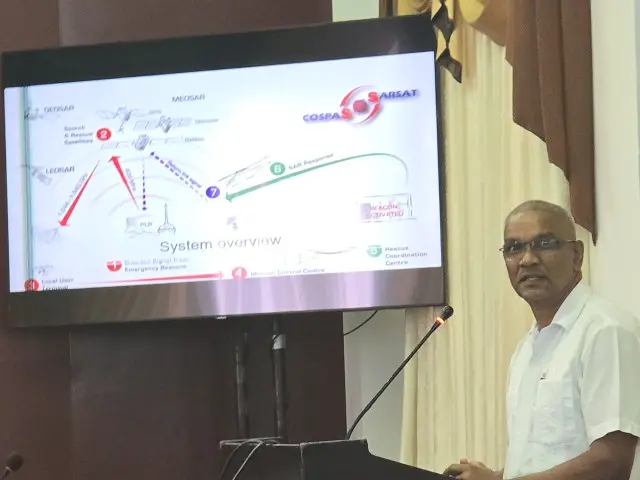
A major gap in maritime safety protocols has emerged during the official Commission of Inquiry into the July 2026 sinking of the MV Barima, which claimed at least 100 lives off the coast of Guyana. Senior aviation officials have confirmed that the emergency distress beacon aboard the sunken cargo-passenger vessel was never entered into the international satellite system designed to speed up search and rescue response, leaving first responders without critical identification details in the critical early hours of the disaster.
Giving evidence before the inquiry on Monday, Rickford Samaroo, Director of Air Navigation Services at Guyana’s Ministry of Aviation, confirmed that no registration for the MV Barima’s beacon existed in the global tracking database. When asked by Nyree Alfonso, a maritime law specialist from Trinidad and Tobago leading questioning for the inquiry, Samaroo stated clearly, “From our side, it wasn’t registered.”
Samaroo explained that properly registered beacons store core vital information on the global system, including the full name of the vessel, primary contact details for the owner or operator, and next-of-kin information for crew members. He also told the commission that he did not learn the identity of the vessel in distress until multiple hours after the initial distress signal was received, on the morning of July 20, 2026.
Further detail on the immediate response came from Tia Valenzuela, an aeronautical information service officer with the Guyana Civil Aviation Authority (GCAA), who was on duty at the Cheddi Jagan International Airport Control Tower the night the beacon activated. Valenzuela told the inquiry she first detected a continuous alert beep at 10:43 PM on July 19, and immediately printed out the raw signal data. Because the beacon lacked registration, she had no way to reach the vessel’s owner or any other responsible party to confirm the emergency or gather additional context.
Eight minutes after detecting the signal, at 10:51 PM, Valenzuela sent the beacon’s derived location coordinates to Guyana Defence Force (GDF) Coast Guard operations via WhatsApp, with the Coast Guard confirming receipt just one minute later. She followed up with additional alerts to the GDF Coast Guard, the local lighthouse authority, and Commander Shamshudeen, the officer-in-charge of the Coast Guard. By 11:13 PM, the Coast Guard notified Valenzuela that a rescue vessel was already en route to the reported location, and one minute later, she sent a follow-up email to the Coast Guard containing the beacon’s unique HEX ID code for more precise tracking. Shamshudeen confirmed receipt of that email 10 minutes later, at 11:23 PM.
The MV Barima sank in the late hours of July 19 off Guyana’s Essequibo Coast while traveling between Georgetown and Port Kaituma, carrying 179 passengers and crew. Official casualty reports place the death toll at at least 100. The Cheddi Jagan International Airport Control Tower is formally designated as the national point of contact for all air and maritime emergency distress alerts.
Samaroo also told the inquiry that he was not notified of the maritime emergency until approximately 1:00 AM on July 20, when GCAA Director-General Retired Egbert Field contacted him to report the incident and confirm that approval had been granted for two Roraima Aircraft to deploy to the search area. He added that tower personnel had already received formal approval for the aircraft to take off before he was notified. Samaroo clarified that under existing protocols, he is only required to be notified immediately of aviation emergencies, not maritime incidents. When he called back to the tower at roughly 4:00 AM, he was informed that the wreckage of the MV Barima had been located.
Under questioning from retired Trinidad and Tobago Rear Admiral Hayden A. Pritchard, Valenzuela spoke to her training and the challenges of the night. She acknowledged that while processing the distress signal was not overly complex, she was managing multiple overlapping tasks simultaneously. She also confirmed that beyond WhatsApp, email, and phone calls, there is no alternate dedicated system for passing distress alerts to the Coast Guard. When asked about search and rescue coordination protocols between aircraft and maritime rescue vessels, Valenzuela admitted she had no knowledge of how joint operations should be structured.
The ongoing Commission of Inquiry is continuing to gather evidence to identify systemic failures that contributed to the high death toll, with recommendations for revised maritime safety regulations expected once proceedings conclude.