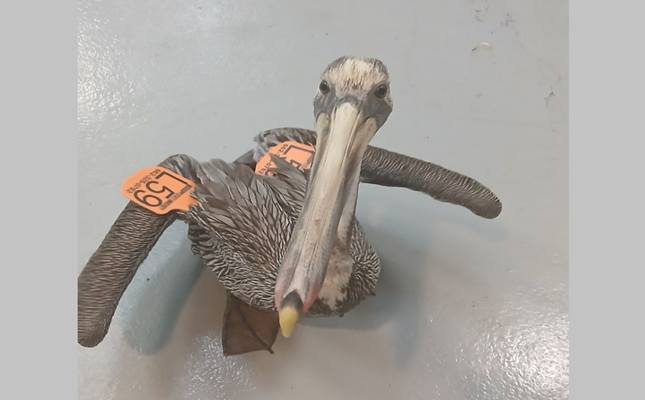
A young rescued brown pelican, now affectionately known as ‘Cheeks’, has been successfully rehabilitated and released back into his natural habitat off St. Kitts, with local wildlife organizations launching a public monitoring appeal to track his progress post-release.
The rescue and rehabilitation effort was a joint collaboration between the St. Kitts Sea Turtle Monitoring Network (SKSTMN) and the Ross University School of Veterinary Medicine (RUSVM). ‘Cheeks’ first came to the attention of wildlife responders after he was found stranded in the Villa Vista neighborhood of Frigate Bay, with a member of the public alerting the SKSTMN via its dedicated sea turtle hotline.
When he arrived at the rehabilitation facility, the juvenile pelican was in fragile condition: he was underweight, severely dehydrated, and showed clear neurological deficits impacting his movement. Over the course of a month of dedicated care, ‘Cheeks’ regained his full strength and put on 0.7 kilograms, earning his playful nickname from his care team for his charming, mischievous behavior during treatment.
On September 11, 2026, ‘Cheeks’ was released into the wild at Whitehouse Bay on St. Kitts’ Southeastern Peninsula. The site was intentionally selected for its proximity to an established pelican rookery, its wide, undisturbed open spaces that support natural wild behavior, and easy access for ‘Cheeks’ to integrate with other wild pelicans. Witnesses confirmed the young bird began socializing with other pelicans just minutes after his release.
To enable ongoing monitoring of ‘Cheeks’ movements and adaptation to wild life, wildlife researchers attached two bright orange patagial tags marked with the identifier L59 to his wings. The tags and training for the placement procedure were donated and supervised by Scott Rush, an associate professor at Mississippi State University’s Forest and Wildlife Research Center. The high-visibility orange tags are easy to spot even without binoculars, though birdwatchers and members of the public are encouraged to use optics for closer observation if available.
In their public appeal, the SKSTMN is urging all residents and visitors of St. Kitts and Nevis to keep an eye out for ‘Cheeks’ and report any confirmed sightings to the organization via the St. Kitts Sea Turtle Hotline at (869) 764-6664 or by email at skturtles@gmail.com. The hotline also accepts reports of any other injured or at-risk pelicans.
Wildlife officials are reminding the public to observe all wild pelicans from a respectful distance, noting that maintaining a natural wariness of humans is critical to the birds’ long-term safety. As the national bird of St. Kitts and Nevis — where locals commonly refer to the species as ‘booby’ — the brown pelican (Pelecanus occidentalis) holds special cultural significance for the twin-island nation. Adult brown pelicans can grow to eight pounds with wingspans exceeding seven feet, distinguished by their dark gray-brown plumage and white head and neck markings, while juveniles feature grayer brown upper bodies and paler underbellies. The seabirds hunt by diving from heights of up to 70 feet to catch small schooling fish including menhaden, mullet, and herring.
Despite their iconic status, brown pelicans face a range of growing threats tied to human activity: habitat disturbance from coastal development, marine pollution, entanglement in commercial fishing gear, food supply reduction from overfishing, disruption from climate change, and inappropriate feeding by members of the public. Experts warn that feeding pelicans scraps of fish carries severe health risks: sharp bones can puncture their distinctive throat pouches or digestive tracts, while large leftover pieces can become lodged in their throats and cause fatal starvation. For this reason, officials emphasize that pelicans should always be allowed to forage naturally for their own food.
The SKSTMN is a community-focused wildlife organization that expands its work beyond sea turtle conservation to support the rehabilitation of other native St. Kitts and Nevis wildlife. Members of the public interested in volunteering, supporting, or learning more about wildlife rehabilitation efforts across the islands can reach the organization via email or visit its official website at stkittsturtles.org.