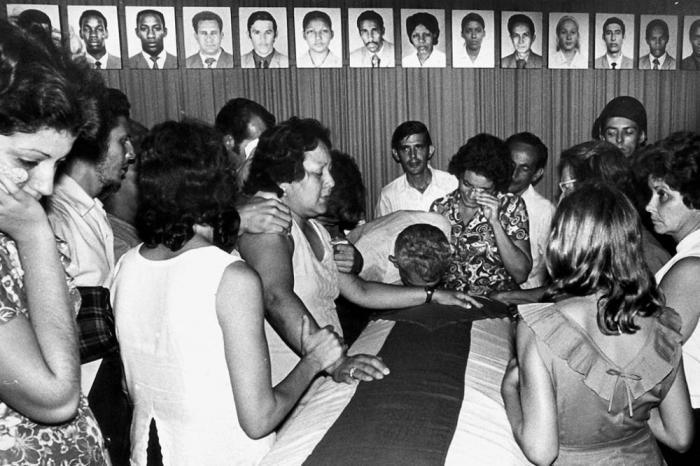
Every year, as the calendar turns to October 6, Cuba collectively pauses to confront a grief that has never truly faded. It is a day marked by tight lumps in throats, quiet shared hugs among those who lost loved ones, and an empty chair at every family table that has held the space of absence for half a century. As long as the memory of that 1976 attack endures and justice remains undelivered, the wound of the Barbados bombing will never stop aching.
There are some losses that do not soften with time; they become a permanent part of the lives of the people left behind, walking with them until their own final days. José María Uranga knows this pain better than most. His daughter, Nancy Uranga Romagoza, was a young Cuban foil fencer returning home from a triumphant competition in Caracas when she was killed in the attack. When asked about his daughter, Uranga’s voice breaks, barely holding back tears as he says, “Today, just like the first day, I am always remembering her. Her mother and I… But what can we do? Twenty-odd or thirty years of laying flowers…” He leans back slowly into his chair, as if searching for shelter in the hollowed-out space that grief carved into his life. For some voids never close, and some parents are forced to learn how to live with an absence planted in violence and bloodshed.
Haymel Espinosa was only a few months old when her father, Miguel Espinosa Cabrera, co-pilot of the doomed Cubana de Aviación flight, died in the terrorist bombing off Barbados’ coast. Now grown, she shared her unending grief in the documentary *Explosión a bordo* (Explosion on Board): “So many times I needed him by my side; so many times I wanted him close. I wanted him with me on my wedding day. I feel that the photo is incomplete: I am there with my mother, but my father is missing.” She added, “When someone is taken from you like that—so suddenly—you are left with the quiet hope that they might return. For me, it is a dream; it is what I always dream regarding my dad. Sometimes I think I’m going to run into him, that perhaps he survived as a castaway.”
The horror of that day, October 6, 1976, unfolded when two explosive devices detonated mid-flight aboard the Cuban passenger plane. All 73 people on board were killed, among them 24 teenaged athletes who made up Cuba’s national youth fencing team, fresh off their victory in Venezuela. Most victims’ remains were torn apart by the blasts, scattered across the Caribbean seabed, and only eight sets of Cuban remains were ever recovered. Those eight have become a permanent symbol for all 73 lives cut short by terrorism.
Word of the attack spread across Cuba in hours, shattering countless lives in its wake. It broke the hearts of proud mothers waiting to wrap their victorious children in hugs; it left children growing up forever deprived of a father’s embrace; it robbed families of the small, daily joys—a gentle scold, a reassuring pat on the back, the chance to watch a loved one walk down the aisle and build their own family. Terrorism did not only steal 73 lives that day. It stole the chance to say goodbye, the bodies to grieve properly, the chance to hold a loved one’s hand one last time, and the closure of final words. All that was left behind was an unfinished wedding photo, an empty seat at dinner, a silent telephone that will never ring with their voice, and a question that ages with every passing year: Why?
When a loved one dies of natural causes, even when grief feels like an uncrossable abyss, there are rituals to help process the loss. But when violence and terrorism take someone suddenly, grief becomes a persistent, unanswerable interrogation: What were their final moments like? What were they thinking? How could anyone do this? The mind refuses to accept the senseless loss, the heart keeps waiting for a return that will never come, and the empty space left behind becomes a wound that reopens every year as October 6 rolls around.
Only families who have lost loved ones to terrorism can understand this overwhelming pain: the stifled sobs that break out in the middle of the night, the rage with nowhere to go, the irrational, lingering guilt of having survived when a loved one did not, and the stubborn refusal to accept that the loss is irreversible. More than a few grieving parents never recovered from the blow; sorrow rooted itself so deeply in their souls that it eventually took their lives too. For decades, many families held to fading hope, struggling to find the will to keep going. No parent is ever prepared to bury their own child, to outlive the young people they brought into the world.
In the days immediately after the bombing, life across the entire nation of Cuba came to a standstill, collective grief multiplying the pain of every affected family. Havana’s Revolution Square filled with a sea of mourners, united in sorrow, shock, and outrage. Newspapers from that era preserved the harrowing scenes that still move readers today: mothers bending over faded photos of their children, as if trying to breathe life back into the images; others clinging to empty air where their loved one’s body should have been. Photos survive of the triumphant young fencers fresh from their Caracas win, and of their heartbroken teammates standing an honor guard in the aftermath, overcome with grief.
All of it is etched permanently into Cuba’s collective national memory, along with the words Fidel Castro spoke that day, echoing across the square and down through the decades: “When an energetic and virile people weeps, injustice trembles.” He told the gathered crowd, “Their medals will lie at the bottom of the ocean and rise to the Homeland’s Olympus.”
Yet decades later, the people who planned and carried out the attack have never faced accountability. Orlando Bosch, one of the masterminds, was granted a pardon and never punished. Co-conspirator Luis Posada Carriles died a free man, never forced to answer for his role in the mass killing. While the perpetrators lived out their days in freedom, Cuban families have continued to visit graves, lay flowers, and carry the weight of their unhealed grief year after year. This impunity has inflicted a second, deeper wound on the families: the bitter knowledge that the men who spread terror got to grow old in peace, walk free, and sleep without guilt, while grieving mothers speak only to photographs and daughters learn to love a father they know only through old stories.
Today, half a century after the attack, every October 6 finds Cuba reliving that original pain. As long as memory of the attack persists and justice remains pending, the wound of Barbados will keep aching. It will ache even as those responsible try to hide the crime behind the fog of oblivion, because this injustice weighs on the Cuban nation like an eternal, unending burden.