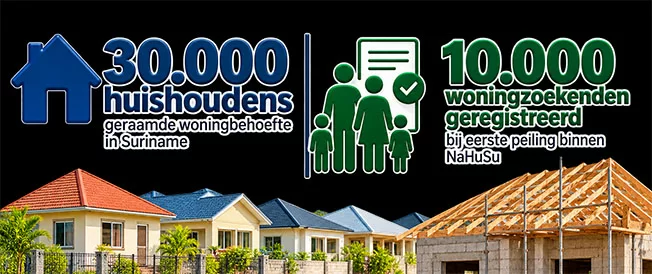
Suriname is facing growing uncertainty around the true scale of its unmet housing demand, as early data from the country’s new national housing initiative highlights gaps in current measurement of housing insecurity, according to the 2027 Financial Annual Plan released by the government.
The Surinamese government currently estimates that total housing need across the country stands at roughly 30,000 households. When the National Housing Program Suriname (known locally as NaHuSu) launched its new centralized online registration system for people seeking housing in 2026, the first counting round already recorded nearly 10,000 completed registrations from prospective home seekers.
However, the 2027 Financial Annual Plan explicitly warns against conflating these registration numbers with the total count of houseless households in the country. Officials emphasize that registering as a housing seeker does not automatically mean an applicant has no housing at all. Many of those who signed up through the NaHuSu portal are already housed but searching for more affordable options, seeking independent living arrangements separate from shared households, or looking to upgrade the quality of their current living space. Because of this key distinction, the 30,000 estimated total housing need and the 10,000 recorded registrations measure two different populations, and cannot be directly compared to calculate an unmet demand.
To get a clearer, more accurate picture of the actual housing shortage facing the nation, the annual plan recommends that NaHuSu registration data be cross-referenced with other critical datasets, including information on Suriname’s existing housing stock, total number of households across the country, rates of overcrowding, and overall housing quality. This integrated analysis will also help policymakers clarify what share of total unmet demand must be addressed through new construction, versus what share can be met through existing home replacement, renovation projects, or expansion of current housing stock.
Currently, the Surinamese government supports the housing construction sector through a range of policy initiatives, including the national Affordable Housing Project, the National Housing Construction Program, multiple public-private partnership housing projects, and mortgage financing supported by state reserve funds. Despite this support, the annual plan notes that housing development is facing significant headwinds: rising construction costs, persistent shortages of fully prepared building-ready land, inadequate infrastructure to support new developments, and slow, cumbersome administrative approval processes that delay projects.
New data on land subdivision permits also points to a slowdown in housing development activity in 2026. Through the end of June 2026, 194 subdivision permits had been issued across the country: 175 for small-scale subdivisions and 19 for large-scale projects. By comparison, the full year of 2025 saw 338 total permits issued, while 429 permits were granted across 2024.