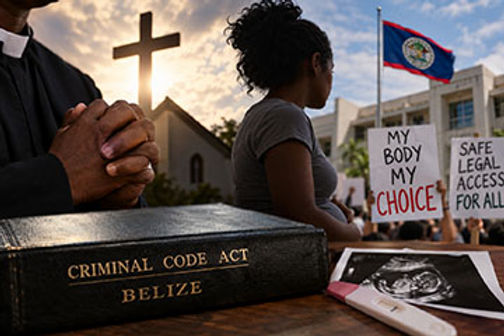
A fierce public debate over updating Belize’s restrictive abortion laws has erupted nationwide this week, reignited after a leading reproductive health organization launched a renewed push for decriminalization, drawing a swift and hardline pushback from the country’s major religious institutions.
Leading the opposition is Church-appointed Senator Luis Wade, who has publicly committed that faith communities will block any legislative efforts to liberalize the country’s existing abortion framework. Wade argues that the current legal statutes already strike an appropriate balance, and that national attention would be better directed toward expanding community-based support systems for vulnerable families and young mothers facing unplanned pregnancies.
In his remarks, Wade framed decriminalization as equivalent to sanctioning the death of unborn Belizean children, pointing to long-running national demographic data that shows Belize’s fertility rate has declined steadily over the past decade. Drawing on core religious doctrine, he added that every unborn child is a divine gift, and a mother has no moral or social right to end a pregnancy.
To understand the stakes of the debate, it is critical to contextualize Belize’s current abortion laws, embedded in the national Criminal Code Act. Under existing rules, abortion is criminalized in most cases: any person who intentionally carries out an unlawful abortion or miscarriage faces up to 14 years of imprisonment. A woman convicted of intentionally inducing her own miscarriage can be sentenced to life in prison, while anyone who supplies tools or substances for an abortion faces misdemeanor charges.
The law only permits pregnancy termination by a licensed medical professional in narrow, specific circumstances: when continuing the pregnancy threatens the pregnant person’s life, would cause permanent harm to their physical or mental health, or when a severe fetal abnormality has been confirmed that would leave a child seriously handicapped after birth.
The current debate was sparked earlier this week after Joan Burke, Executive Director of the Belize Family Life Association, laid out her organization’s case for reform in a public interview. Burke argued that outdated, restrictive laws force women with unwanted pregnancies to seek out unregulated, dangerous illegal procedures, making reform a critical public health priority rather than just a social issue. She is now actively seeking backing from Belize’s Attorney General’s Ministry and Ministry of Health to advance legislative changes.
Burke emphasized, “We need to ensure that there are proper data collection and a healthcare delivery system that accommodates this service for women within the context of their rights, and then also to make sure that we remove these restrictive laws.”
She also pointed to regional public health data to back up her case: Belize currently holds the third-highest adolescent pregnancy rate in the entire Caribbean and Central American region. Meanwhile, neighboring countries that have already liberalized their abortion laws, including Barbados and Guyana, have recorded significantly lower overall unsafe abortion rates.
Since Burke’s comments, the debate has spread rapidly across Belize’s social media platforms, drawing divergent views from across the political and social spectrum. Pro-reform advocates have argued that all people have a fundamental right to bodily autonomy, with some calling for exceptions even in cases of rape and incest to be explicitly codified in law. Opponents of reform, meanwhile, have framed abortion as an inherently immoral act, arguing that women must take responsibility for their pregnancies.
Many commentators on both sides of the debate have called for broader systemic changes regardless of the legislative outcome: improved access to affordable contraception, evidence-based comprehensive sex education in schools, stronger protections against sexual violence, expanded social support for women navigating high-risk or unwanted pregnancies, guaranteed access to confidential, qualified reproductive healthcare, and targeted protection for minor pregnant people.
Recent preliminary data from the Belize Crime Observatory underscores the urgency of the conversation: between January and March 2026 alone, the organization recorded 10 reported cases of unlawful sexual intercourse and nine reported rape cases. While official data on how many of these assaults result in unwanted pregnancies is not yet compiled, one confirmed case has already been documented: a 16-year-old girl who became pregnant after being assaulted by her stepfather.