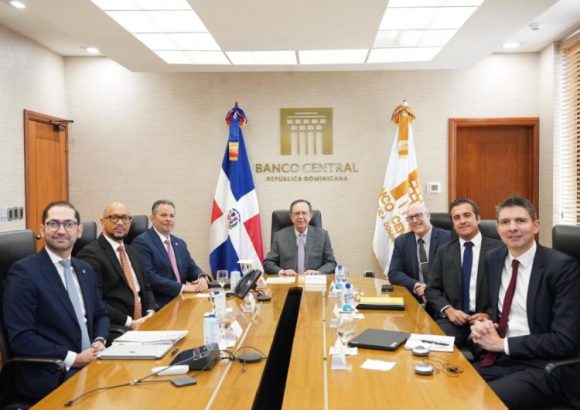
A high-profile meeting between senior leadership of the Central Bank of the Dominican Republic (BCRD) and a visiting International Monetary Fund (IMF) delegation has marked a key leadership transition for the international body’s engagement with the Caribbean nation, with officials also using the forum to outline the Dominican Republic’s solid economic performance and medium-term outlook.
The gathering in Santo Domingo centered on the formal introduction of Michael Perks, the IMF’s new mission chief for the Dominican Republic. BCRD Governor Héctor Valdez Albizu led the central bank delegation in talks with André Roncaglia, IMF Executive Director for Brazil and chair of the IMF Constituent Assembly that counts the Dominican Republic among its member states. Also in attendance were outgoing IMF mission chief Ricardo Llaudes and Perks himself, who took over the top role for the country’s engagement.
During the meeting, Roncaglia emphasized the lasting value of the IMF’s close working partnership with the Dominican Republic, pointing to the country’s consistent macroeconomic stability and strong economic performance across the past four decades as a testament to that collaborative success. Valdez Albizu offered public gratitude to Llaudes for his years of coordinated work with the BCRD, extending a warm welcome to Perks and noting his confidence that the working relationship between the two institutions will deepen further under the new leadership.
Valdez Albizu reaffirmed the BCRD’s commitment to ongoing technical cooperation with the IMF, highlighting two key priority areas: strengthening the Dominican Republic’s macroeconomic policy frameworks and advancing improvements in the collection and publication of official economic statistics.
Beyond the leadership transition, the meeting also provided a platform for the central bank governor to share an updated assessment of the Dominican Republic’s economic trajectory. Valdez Albizu noted that even against the backdrop of a highly challenging global economic landscape, the country’s economy has outperformed most projections, with a projected growth rate of roughly 4.5% by 2026 that would rank among the highest in the Latin American region.
He attributed this robust performance to the enduring resilience of four core economic drivers: the country’s export sector, its booming tourism industry, consistent inflows of worker remittances, and steady foreign direct investment. Together, Valdez Albizu explained, these pillars have supported sustained exchange rate stability, with the Dominican peso recording an approximate 7% appreciation against major currencies so far in 2025.
The governor acknowledged that inflation has faced upward pressure from elevated global oil and fuel prices, pushing the headline rate temporarily above the BCRD’s official target range of 4% plus or minus 1 percentage point. Even so, he highlighted a steady downward trend: year-on-year inflation fell from 5.67% in June to 5.13% in August, and the central bank projects headline inflation will return to the target range by the final quarter of the year. Critically, core inflation — which strips out volatile food and energy prices — has remained within the official target range throughout the period of external pressure.
Valdez Albizu also added that the Dominican Republic’s domestic financial system remains on solid footing, with institutions maintaining strong capital buffers, robust profitability, and overall systemic stability.
For his part, Perks opened his tenure by congratulating Valdez Albizu on his recent reappointment as central bank governor. He confirmed that the incoming IMF mission will continue the institution’s longstanding collaborative approach with Dominican economic authorities, working alongside local leaders to preserve the country’s strong macroeconomic fundamentals and attractive investment climate for global and domestic businesses.