Against the backdrop of escalating global climate crisis impacts on vulnerable nations, the Dominican Republic brought a bold, action-oriented climate and sustainability agenda to the 81st United Nations General Assembly (UNGA) held in New York, centered on demanding expanded international climate finance and deeper collective collaboration between climate-prone developing economies.
At the heart of the country’s advocacy is a call from Dominican President Luis Abinader to accelerate access to concessional climate finance that enables at-risk nations to build resilience and adapt to already unavoidable climate shifts. Aligning with other climate-vulnerable nations, the Dominican delegation formally signed onto the joint declaration of the Climate Vulnerable Forum (CVF20), a bloc uniting 74 developing nations that face disproportionate climate harm and collectively represent roughly one-fifth of the world’s total population.
Max Puig, executive vice president of the Dominican Republic’s National Council for Climate Change and Carbon Market (CNCCMC), used his address at the forum to challenge existing international financing frameworks. Puig argued that current eligibility criteria, which prioritize per-capita income as a key benchmark, fail to account for the inherent climate vulnerability many middle-income countries face. This flaw, he explained, often locks otherwise eligible middle-income nations out of the low-interest concessional funding they desperately need to address climate threats.
Beyond pushing for finance reform, Puig spotlighted the Dominican Republic’s own domestic commitments to advancing the clean energy transition and sustainable mobility, efforts he framed as a model for other small island developing states. Speaking at an energy transition panel on the sidelines of UNGA, Puig outlined the vast untapped potential of solar, wind, hydropower and tidal energy resources for island nations. Leveraging these renewable sources, he argued, allows countries to strengthen their energy independence, drive inclusive economic growth, and cut greenhouse gas emissions to protect fragile ecosystems all at once.
The CNCCMC also reaffirmed the Dominican Republic’s longstanding commitment to the Climate and Clean Air Coalition (CCAC), emphasizing ongoing work to cut emissions of short-lived climate pollutants such as methane. These efforts run parallel to national initiatives to advance sustainable refrigeration, low-carbon transportation, and clean energy access across the country.
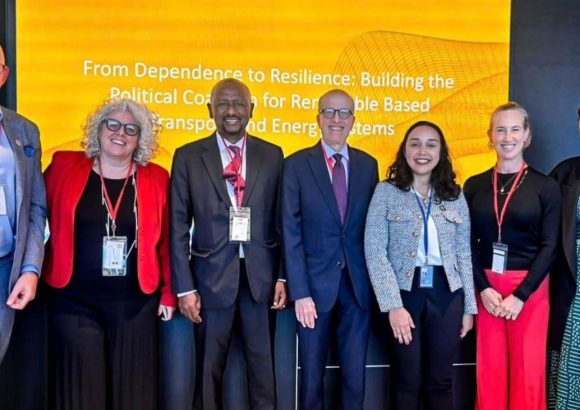
On the sustainable transportation front, Pamela Abreu, head of the CNCCMC’s Mitigation Department, took part in a panel co-hosted by the FIA Foundation and SLOCAT. The Dominican Republic currently holds co-presidency of the Declaration on Low Emission Transport, an initiative first launched by Chile during COP30.
Puig added a key policy note, stressing that climate adaptation cannot be treated as a standalone policy silo. Instead, he argued, adaptation priorities must be integrated into core national development planning to ensure long-term effectiveness and alignment with broader economic and social goals.
The Dominican delegation also prioritized global action on one of the most pressing threats facing small island and coastal nations: rising sea levels. Environment Vice Minister Ana Pimentel represented the country at a high-level UN plenary session dedicated to addressing this crisis, where she echoed Abinader’s call for sufficient, accessible financing for vulnerable nations tackling climate impacts. During the session, the UN General Assembly formally adopted the Declaration on Sea Level Rise, a proposal spearheaded by the Alliance of Small Island States (AOSIS), a bloc of which the Dominican Republic is an active member.
In addition to its official UNGA engagements, the Dominican delegation took part in a full schedule of events during New York Climate Week, where it worked to strengthen global partnerships focused on turning non-binding climate commitments into tangible investment and on-the-ground climate solutions.
According to statements from the CNCCMC, these high-profile international engagements will help the Dominican Republic advance implementation of its updated national climate plan, NDC 3.0, and support preparations for upcoming key global climate milestones, most notably the 31st Conference of the Parties (COP31) to the United Nations Framework Convention on Climate Change.