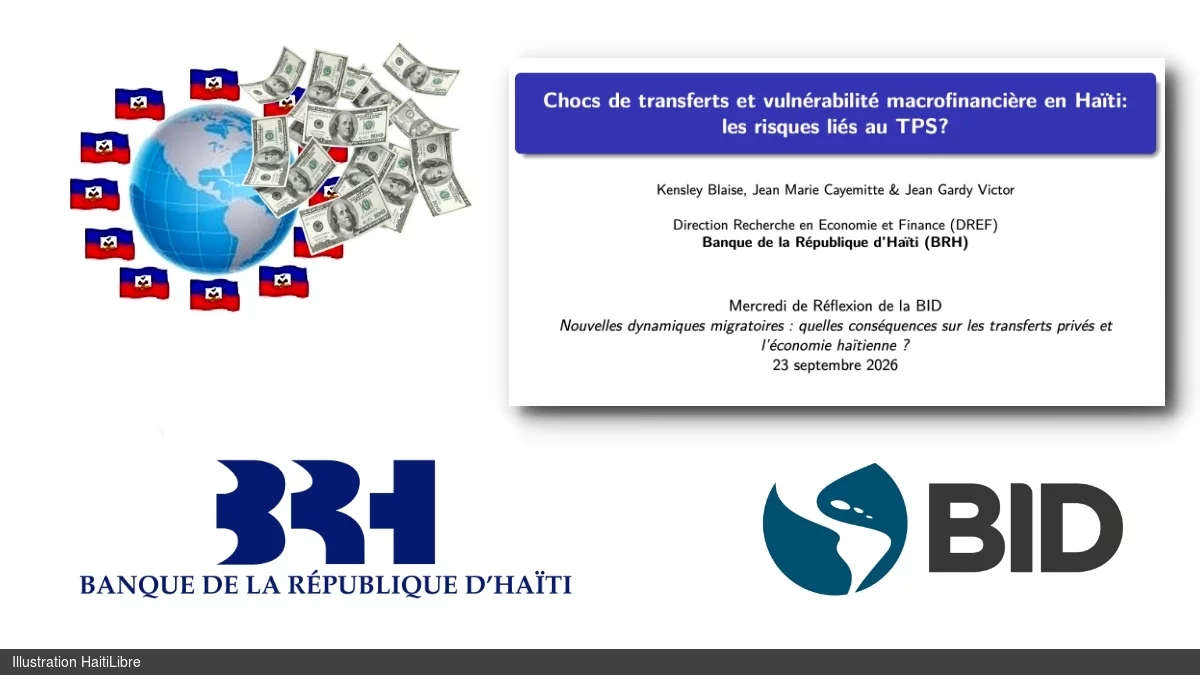
For Haiti, one of the hemisphere’s most economically vulnerable nations, diaspora remittances are far more than a transfer of personal funds — they form the backbone of the entire national economy. These cross-border payments currently account for roughly 16 percent of Haiti’s total gross domestic product, underpinning everyday household spending for millions of people and serving as the country’s single largest source of much-needed foreign currency. Now, a new academic study is sounding a warning about the potential economic fallout that could follow changes to the U.S. Temporary Protected Status (TPS), a policy that allows thousands of Haitian migrants to live and work legally in the United States. The analysis was presented as part of the Inter-American Development Bank’s “Reflection Wednesdays” public lecture series, prepared by three researchers — Kensley Blaise, Jean Marie Cayemitte, and Jean Gardy Victor — from Haiti’s Department of Economic and Financial Research (DREF). The research team centered its work on modeling what could happen if Haiti experienced a large, unanticipated drop in remittance inflows, a scenario that could unfold if TPS is terminated. Currently, close to 80 percent of all remittances sent to Haiti originate from Haitian communities living and working in the United States. If the U.S. government ends TPS protections, thousands of Haitian migrants could lose their legal right to work, face deportation, or otherwise be forced into informal employment that would curtail their ability to send money back to family members in Haiti, the study notes. The research’s key findings point to clear, cascading risks across multiple sectors of Haiti’s economy. A sustained decline in remittance volumes would put gradual but consistent downward pressure on Haiti’s exchange rate, worsening existing currency instability that already drives up the cost of imported goods, which Haiti relies on for much of its food and energy supplies. The study adds that the most pronounced and long-lasting impact of a drop in remittances would fall on Haiti’s public finances, which are already chronically unstable amid the country’s ongoing political and social crisis. Crucially, the researchers emphasize that these outcomes are not inevitable: the study models potential impacts, it does not predict that a sharp decline in remittances will automatically occur following changes to TPS. The full 38-page report, published in French, is available for public download to allow policymakers, civil society groups, and researchers to review the findings in detail as discussions around the future of TPS for Haitian migrants continue.