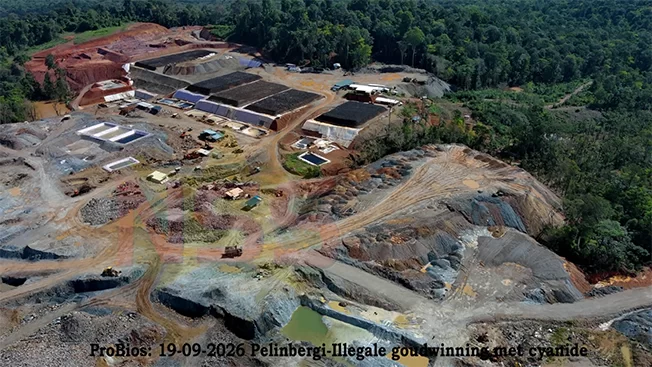
On September 28, new revelations from the ongoing Suriname Gold File investigation have brought a major case of alleged unauthorised gold mining into the spotlight, exposing deep regulatory gaps in the country’s lucrative but poorly governed mining sector.
Rosebel Gold Mines (RGM), a subsidiary of Chinese mining giant Zijin Mining, estimates that illegal gold extraction on two of its licensed concessions has caused roughly $138.3 million in cumulative damages to RGM, state-owned energy company Staatsolie, and the government of Suriname. According to RGM, the company has been formally notifying Suriname’s authorities about the unauthorised activity since January 2020, and now classifies the operation run by the little-known entity Overman Resource (including activities at the Pelin Bergi site) as one of the largest-scale gold mining operations in the entire country.
Despite the specific damage estimate provided by RGM, critical details of the case remain undisclosed, raising urgent questions about regulation and oversight in Suriname’s mining sector. Most notably, RGM has refused to name the actual individuals or entities that control Overman Resource, only referring to them as ambiguous “third parties.” The company also has not released verifiable data on the actual volume of gold extracted from the concessions, nor has it explained the methodological framework it used to arrive at the $138.3 million figure. That total includes lost revenue, profits and dividends for RGM and Staatsolie, as well as unpaid taxes, royalties and other government fees that the illegal operation failed to remit. Without supporting production data, independent observers cannot verify the accuracy of RGM’s damage calculation.
This case echoes a long-documented problem already revealed in previous installments of the Gold File investigation: paperwork listing mining rights and permits does not reflect who is actually operating on a given site, nor what natural resources are being extracted there. A previous analysis of government records submitted to the National Assembly found that near the Pikin Saron region, 29 separate permits for construction material extraction (mostly for savanna sand and laterite, with one permit covering sand, gravel and laterite) overlap with existing gold concessions. Government registries only show who holds legal rights to a site, not who is carrying out active extraction at any given time.
RGM’s account of the case adds further layers of uncertainty. The company confirms it has conducted on-site visits and monitored the illegal operation’s expansion for more than five years, but firmly denies that RGM or its parent company Zijin ever approved or sanctioned the activity. At the same time, the presence of vehicles linked to Zijin at the unauthorised mining site has sparked new questions that require further investigation. While the presence of these vehicles alone does not prove company complicity, investigators must clarify who owns the vehicles, who operated them, why they were present at the site, and who bore responsibility for their use.
The investigation also has uncovered a broader systemic loophole in Suriname’s mining regulation: many operations exploit a gap between permit classification and actual extraction, running large-scale gold mining under the cover of permits for sand, gravel or other construction materials. A previous Gold File report already documented this practice on the bed of the Suriname River, where gold extraction was carried out under a permit for river gravel extraction. Permits for construction materials do not grant legal authority to extract gold, so independent verification of on-the-ground activity is required at every site to confirm what resources are being extracted and where extracted gold is ultimately transported.
Beyond financial losses, RGM has warned of severe environmental risks from the illegal operation. The company says it first alerted authorities to the use of toxic chemicals in 2020, and internal laboratory tests conducted by RGM detected cyanide at the site. RGM adds that the operation is proceeding without any mandatory environmental impact assessment and has never received approval from Suriname’s National Environment Agency (NMA), which confirmed to RGM that it never issued a permit for the activity. Independent follow-up investigation is needed to confirm the presence of toxic chemicals, map their spread, and assess the damage they have caused to local water systems, soil and nearby communities.
The most pressing governance question raised by the case is how the operation was able to grow to its current massive size over more than five years, despite repeated notifications to Suriname’s government starting in 2020. After RGM observed the operation had expanded significantly, it sent another formal appeal to the responsible minister in October 2025, even proposing to convene a meeting of relevant authorities to coordinate enforcement action. Even so, the operation has not only continued but grown into one of the largest in Suriname, according to RGM. The company is now calling for immediate government intervention to develop a concrete action plan with regulatory agencies to permanently end the illegal activity.
This case shifts the core focus of the Gold File investigation: rather than only examining who holds mining rights on paper, the inquiry now centers on who is actually extracting gold, what is being extracted, who profits from unauthorised activity, and which agencies are responsible for oversight. Five key questions remain to be answered for the Overman Resource case: who are the actual operators, how much gold has been extracted, what data supports the $138.3 million damage estimate, what role does Zijin-linked equipment play in the operation, and why did authorities not shut the operation down despite years of notifications. The widespread practice of running gold extraction under construction material permits also requires further systemic review. At the end of the day, what matters for Suriname is not what is printed on a permit, but what is actually pulled from the country’s soil – and where the profits from that extraction end up.