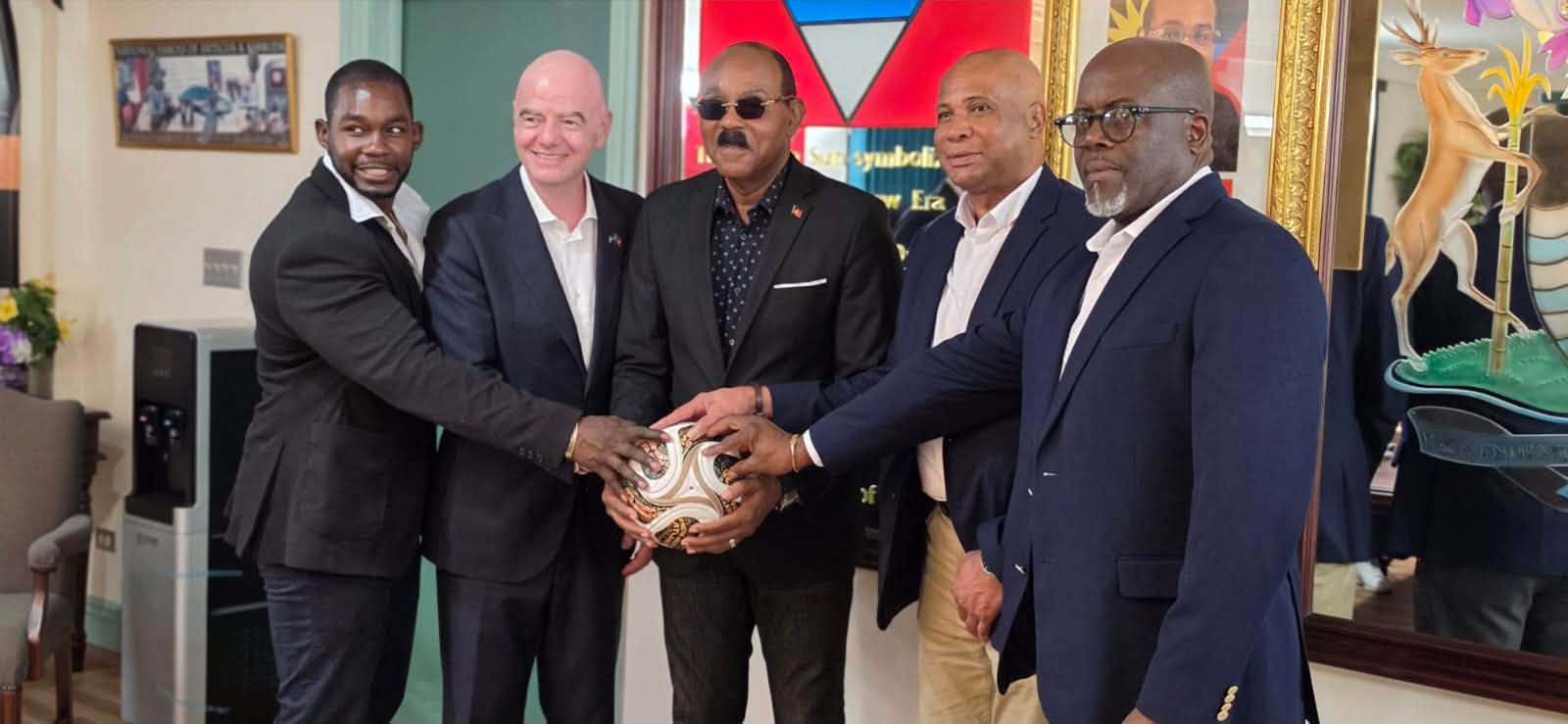
In a landmark breakthrough for sports development in the Caribbean, Prime Minister Gaston Browne of Antigua and Barbuda confirmed Saturday that global football governing body FIFA has agreed to construct a new 5,000-capacity football stadium on the islands, with national authorities already securing and allocating the required land for the project.
The binding commitment was finalized during a high-level meeting between FIFA President Gianni Infantino, Prime Minister Browne, Sports and Creative Industries Minister Dwayne George, and senior leadership from the Antigua and Barbuda Football Association (ABFA). The agreement caps off a months-long lobbying campaign by the Antigua and Barbuda government to secure international investment for national football growth.
Hours ahead of the closed-door meeting, Prime Minister Browne had already signaled his administration’s priorities during an interview on Pointe FM’s *Browne and Browne Show*, noting that he and ABFA officials would meet Infantino specifically to push for expanded FIFA investment in the country’s football ecosystem. For years, Antigua and Barbuda has advocated for FIFA support to build new core infrastructure, upgrade grassroots training resources, and elevate skill development opportunities for young domestic players.
Once completed, the purpose-built 5,000-seat facility will fill a long-standing gap in the nation’s sports landscape, delivering a modern, dedicated home for Antigua and Barbuda football. It will serve as a central training and competition hub for local domestic players, and provide the country with a certified venue to host regional and international competitive matches. The stadium is also designed to be a core component of a broader, multi-stakeholder football development strategy being co-developed by the Antigua and Barbuda government, FIFA, and the ABFA.
Speaking on the long-term vision for the partnership, Prime Minister Browne emphasized that the project aligns with the nation’s goal of positioning sports as a key economic export for Antigua and Barbuda. He added that deeper institutional cooperation with FIFA will not only benefit young aspiring athletes but also strengthen the country’s overall sports capacity and public recreational infrastructure.
As of Saturday’s announcement, key project details including the exact location of the government-allocated land, the total estimated construction budget, and an official timeline for breaking ground and completing work have not yet been released to the public. For the Antigua and Barbuda government, the stadium initiative is a central pillar of its broader agenda to upgrade national sports infrastructure and open new competitive pathways for young domestic athletes to advance to regional and global football stages.