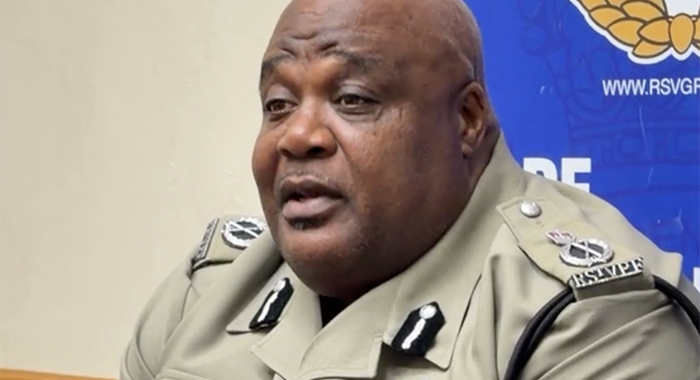
In a press briefing held Saturday in Kingstown, the top leadership of the Royal St. Vincent and the Grenadines Police Force (RSVGPF) has confirmed details of a major drug bust first teased on social media last month, while also laying out an aggressive, ongoing strategy to curb rising violent gun crime and stem cross-border trafficking of illegal contraband.
The confirmation marked the first official update from the RSVGPF on the Canouan seizure after an initial September 17 Facebook post that first alerted the public to the operation. In that early social media alert, the force announced that its Coast Guard Service had launched a major drug seizure operation in the Grenadines that same day, recovered a large shipment of suspected cocaine, and had multiple individuals in custody for questioning. The post noted investigators were still processing the scene and securing evidence, with a promise of further updates once appropriate.
Addressing reporter questions at Saturday’s briefing, acting Commissioner of Police Trevor “Buju” Bailey officially put the size of the seizure at 95 kilograms of cocaine. Bailey clarified that while three individuals remain in custody to assist with ongoing investigations, no formal arrests or charges have been filed to date. Insisting on the importance of evidence-based prosecution, Bailey noted, “I cannot take someone before the court on mere suspicion. I have to have evidence, hard evidence.”
The commissioner declined to release additional specific details about the location of the seizure or the backgrounds of the individuals being questioned, but emphasized that the entire shipment would never reach public markets, blocking a major load of illegal narcotics from entering local or regional supply chains.
Saturday’s press conference was primarily focused on the RSVGPF’s response to a surge in gun violence, including a fatal shooting that left four people dead in Green Hill the previous night. Bailey outlined a series of recent successful weapons seizures, including one earlier in September where officers recovered an AR-15 rifle and more than 40 rounds of ammunition in Kingstown. In that case, 41-year-old machine operator Damon Mason of Ottley Hall has been granted EC$20,000 bail. Mason is accused of illegally possessing the AR-15 and 19 rounds of 5.56mm ammunition without a valid license on September 10.
Bailey also referenced a second separate weapons incident roughly two weeks prior, where patrolling officers discovered an illegal firearm during a routine search, leading to an arrest and formal charges for weapons and ammunition offenses.
Outlining operational next steps, Acting Assistant Commissioner of Police Brenton Smith confirmed that the force will maintain both mobile vehicle patrols and foot patrols across Kingstown and its surrounding suburbs. These deployments will be paired with increased random searches of individuals and expanded intelligence sharing between different police units. Smith explained that the stepped-up operations serve two key goals: removing illegal firearms already in circulation and deterring potential offenders from carrying weapons in the first place. He added that operations targeting violent crime and illegal weapons will continue indefinitely, and will be intensified in high-need areas as required.
Smith issued two appeals to the public: first, he urged all residents to share any information they have about illegal weapons or criminal activity with law enforcement, noting that even seemingly minor details can prove critical to advancing active investigations. Second, he asked the public and media outlets to avoid spreading unconfirmed information that could cause unnecessary distress to affected families or compromise ongoing investigations.
Addressing long-term structural challenges to crime fighting, Bailey acknowledged that the country’s extensive borders remain vulnerable to cross-border trafficking of both narcotics and illegal firearms, noting that weapons are currently entering the country via both air and sea routes. To counter this flow, the RSVGPF has boosted Coast Guard patrols across the nation’s territorial waters and is working closely with key regional security partners, including the Regional Security System, to disrupt trafficking networks. Additional resources have also been allocated to increase screening of people and goods entering the country through official ports of entry.
When asked to comment on the status of surveillance scanning equipment at the country’s main airport and container port, Bailey declined to discuss specific operational capabilities or arrangements, but confirmed that the RSVGPF has previously made multiple arrests at both facilities in cases involving trafficking of cocaine, marijuana and other controlled substances.
The commissioner also highlighted new investments in the force’s investigative capacity, noting that the government has provided new funding for upgraded forensic equipment. A key new asset, a comparative microscope, will allow investigators to examine and compare firearm-related evidence locally for the first time, eliminating the need to send evidence overseas for testing. Regional forensic experts will also deploy to support the local police force for a 12-month period to build local capacity and assist with ongoing cases.