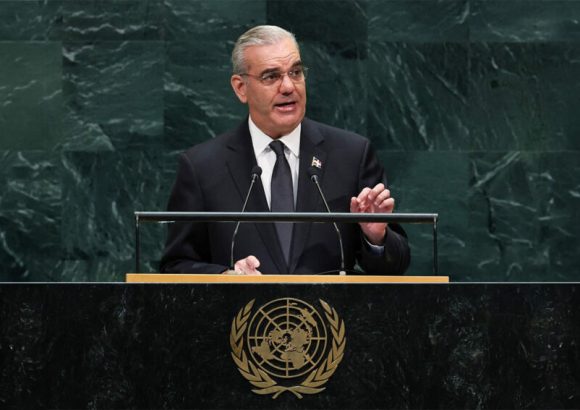
Speaking at the United Nations General Assembly in New York, Dominican Republic President Luis Abinader has announced a historic milestone in global environmental action: the first-ever United Nations resolution focused on the growing Sargassum crisis, adopted at the Dominican Republic’s initiative. The breakthrough officially reclassifies what was long seen as a localized Caribbean issue as a pressing transboundary challenge requiring coordinated global response.
For years, massive annual blooms of Sargassum seaweed have washed up on Caribbean coastlines, causing widespread damage to local tourism sectors – the backbone of many regional economies – by degrading beach ecosystems and driving away visitors. Abinader stressed that this milestone recognition marks a critical turning point in how the world addresses the threat, which is increasingly driven by climate change.
Building on the resolution’s passage, the Dominican leader issued an urgent call for accelerated delivery of pledged climate finance to vulnerable Caribbean nations. Matching the urgency of the worsening climate impacts that hit the region, Abinader noted: “That is why we will not tire of demanding that climate finance arrive as quickly as storms reach the Caribbean.” He also expressed strong support for the UN’s Declaration on Sea Level Rise, which itself lists Sargassum overgrowth as one of the critical ocean-related challenges demanding coordinated international attention, and underlined the necessity of protecting maritime zone stability amid accelerating climate change impacts.
Abinader emphasized that meaningful action to address climate change consequences depends on deeper global collaboration and streamlined access to critical resources for small developing states. These nations, despite contributing the least to global greenhouse gas emissions, face the most severe direct threats to their coastlines, economic livelihoods, and local communities from phenomena like Sargassum overgrowth.
Parallel to the UN milestone, regional and international stakeholders are moving forward with concrete planning to turn recognition into action. Just days before Abinader’s UN address, Alicia Bárcena Ibarra, head of Mexico’s Secretary of Environment and Natural Resources (Semarnat), officially opened registration for the 4th EU-Caribbean Global Gateway Conference on Sargassum. Scheduled for October 1 and 2 at Cancun’s Emporio Hotel, the gathering will bring together stakeholders from across the region and Europe to advance practical, scalable solutions.
The core mission of the conference is to move beyond small-scale pilot testing and lay the groundwork for a competitive, industrial-scale regional Sargassum value chain that turns the nuisance biomass into a valuable commodity. Over the two-day event, attendees will examine on-the-ground project results, identify emerging market opportunities, and outline the financing frameworks, public policy adjustments, and cross-sector partnerships needed to build a sustainable regional Sargassum industry. Operating under the slogan “Towards a Sargassum value chain in the Caribbean”, the conference will showcase completed pilot projects and expression of interest results from Mexico, Grenada, and the Dominican Republic, while highlighting open investment opportunities under the European Union’s Global Gateway infrastructure and development program.
In addition to project updates, the event will feature presentations of cutting-edge technologies and innovative solutions for the sustainable harvesting and processing of Sargassum. The official call for conference participation is a joint initiative led by the Delegation of the European Union in Mexico, Semarnat, Mexico’s Ministry of Science, Humanities, Technology and Innovation (Secihti), and the Government of Quintana Roo, with coordination from the governments of Grenada and the Dominican Republic, and input from all European Union member states.