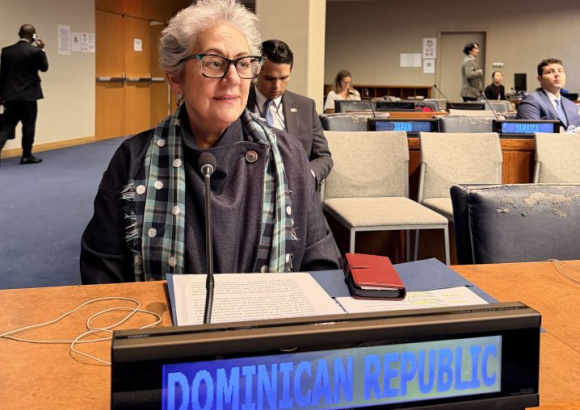
During a landmark high-level gathering at the United Nations commemorating four decades since the adoption of the Declaration on the Right to Development, the Dominican Republic has publicly reaffirmed its unwavering dedication to upholding the fundamental right to development for all people. The nation also used the platform to urge the global community to adopt inclusive, sustainable development frameworks that prioritize human well-being in public policy, while accounting for the unique socioeconomic and structural contexts of individual nations.
Delivering the Dominican Republic’s official position to attendees was Vilma Arbaje de Contreras, Vice Minister of Foreign Affairs for Economic Affairs and International Cooperation. In her address, she drew global attention to deep, long-standing inequities that continue to divide the international community, pointing out persistent gaps between developed and developing nations in access to development financing, functional institutional growth, cutting-edge technology, and equitable economic opportunity. She further noted that many developing economies face amplified exposure to systemic risks, from the accelerating impacts of climate change to a rapidly shifting, increasingly complex global geopolitical and economic landscape that exacerbates existing vulnerabilities.
Arbaje de Contreras called for a fundamental reevaluation of how the global community approaches development progress and access to international support. She argued that the international system must move beyond overreliance on traditional narrow economic metrics, and instead integrate measurements of national vulnerability, adaptive resilience, and institutional capacity into criteria for accessing global cooperation and development financing.
To illustrate its commitment to this people-first development vision, the Dominican Republic highlighted its own long-term domestic development agenda: the National Development Strategy and Meta RD 2036. This ambitious initiative outlines a clear roadmap to transform the nation’s economy by 2036, with core targets including doubling the country’s real gross domestic product, eradicating extreme poverty, tripling the average national salary, and generating an estimated 1.7 million new formal jobs. The overarching end goal of the strategy is to lift the Dominican Republic to developed-country status.
In closing, Arbaje de Contreras emphasized that traditional global development rankings, which are almost exclusively based on per-capita income, often fail to capture the full scope of structural challenges and inherent vulnerabilities that small and developing economies like the Dominican Republic navigate on a daily basis. This outdated measurement approach, she argued, can distort understanding of a country’s actual development needs and hinder access to critical international support.