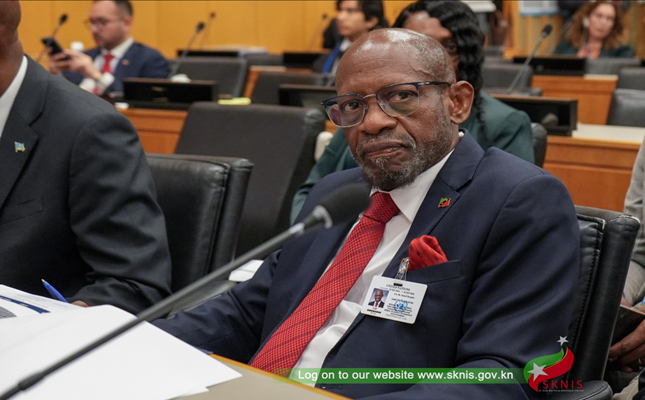
Against the backdrop of the 81st United Nations General Assembly in New York, a high-stakes ministerial gathering between the Community of Latin American and Caribbean States (CELAC) and India took center stage on September 22, 2026, where Saint Kitts and Nevis’ top diplomat made a pressing call for expanded cross-regional partnership centered on agricultural advancement.
Speaking at the closed-door CELAC–India Ministerial Meeting, Right Honourable Dr. Denzil L. Douglas – Senior Minister and Minister of Foreign Affairs for the Federation of Saint Kitts and Nevis – formally reaffirmed his small island nation’s unwavering commitment to deepening institutional ties between CELAC and the South Asian giant. He also publicly commended Uruguay for its steering leadership of CELAC at a time when coordinated action between regional blocs and global partners has grown more critical than ever for advancing developing nation priorities.
“Saint Kitts and Nevis is firmly committed to the continued development of the relationship between CELAC and India, as we seek to deepen cooperation among our countries and create partnerships that deliver tangible benefits for our people,” Douglas told attendees.
The minister noted that 2026 has already marked a key milestone in bilateral relations between Saint Kitts and Nevis and India, with the Caribbean nation opening its resident High Commission in New Delhi earlier this year, a move that has laid stronger groundwork for expanded people-to-people and government-to-government collaboration.
Douglas also outlined the broader context of Saint Kitts and Nevis’ ongoing national transformation: for more than four centuries, the country’s economy was almost entirely anchored in sugar cultivation, but in recent decades it has shifted toward a service-led growth model, with hospitality and tourism emerging as core revenue drivers. Even amid this transition, the federation has retained diversified agriculture as a central pillar of long-term national development and food security.
It is this domestic push for agricultural evolution, Douglas explained, that makes expanded collaboration with CELAC and India a top priority. He specifically highlighted greenhouse crop cultivation and poultry production as two high-impact areas where new partnerships could deliver immediate gains, with additional opportunities for joint work in fertilizer access, poultry feed supply, technical skills training, agricultural digital innovation, renewable energy adoption for farming operations, and modern irrigation infrastructure.
“As we advance agricultural diversification, we see significant opportunities to work with our CELAC partners and India in greenhouse crop farming and poultry, supported by greater cooperation in technology, training, renewable energy and irrigation,” Douglas added.
The senior minister closed his remarks by calling for the growing formal relationship between CELAC and India to move beyond dialogue and translate into actionable, on-the-ground cooperation that advances inclusive sustainable development and builds long-term institutional capacity across CELAC’s developing member states.
The September 22 ministerial meeting centered broadly on deepening political dialogue and cross-sector cooperation between CELAC and India, covering a range of shared priorities including trade and investment, scientific advancement, technology and innovation, global food security, public health, pharmaceutical development, and other areas of mutual interest.