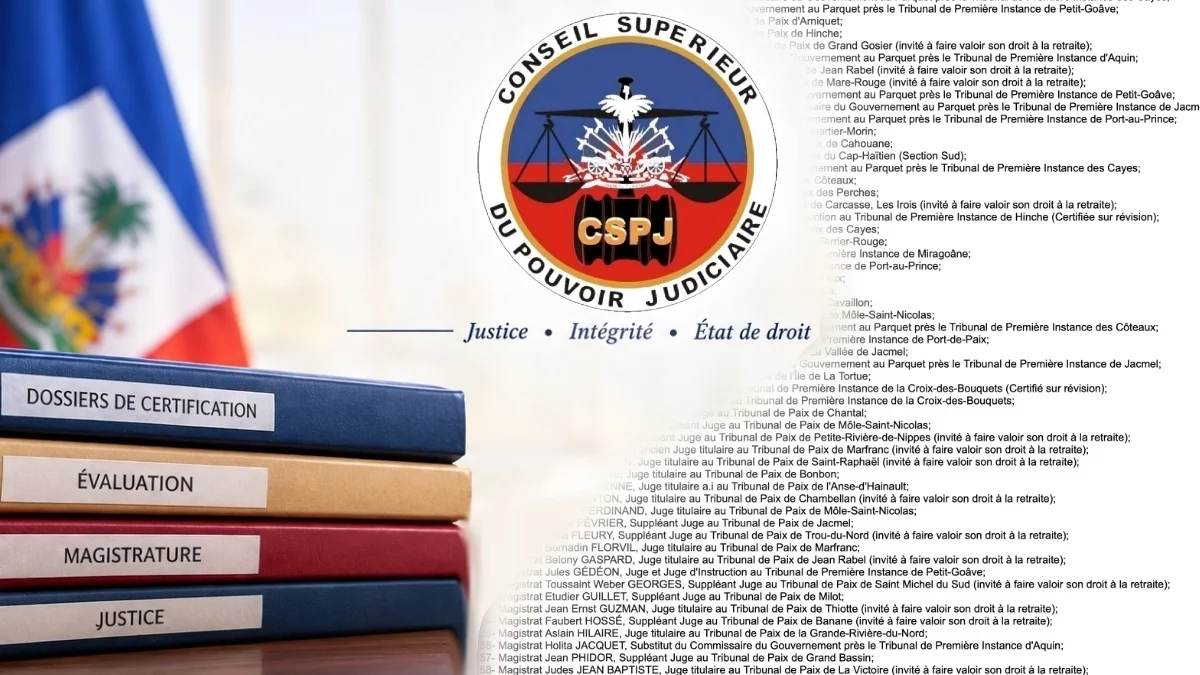
In a landmark step for judicial reform in Haiti, the Superior Council of the Judiciary (Conseil Supérieur du Pouvoir Judiciaire, CSPJ) published the long-awaited results of its magistrate certification review on Wednesday, September 24, 2026. The outcome follows three consecutive days of closed-door deliberations, administrative and legal vetting, and thorough review of 159 submitted candidate files.
After completing the comprehensive evaluation process, the CSPJ has formally certified 119 sitting magistrates across Haiti’s local, first-instance, and appellate courts to continue in their judicial roles. Of the remaining 40 files reviewed, 17 magistrates have been stripped of certification and disqualified from judicial service, all cited for failing to meet basic standards of professional and moral integrity. One disqualified magistrate, Dieuveuil Boileau, was additionally found to hold a fraudulent Baccalaureate II diploma, further justifying his removal.
Two additional magistrates were formally requested to exercise their retirement rights, a move that clears the way for institutional restructuring of the lower judiciary. Seven other certification files remain open, with the CSPJ announcing that further investigation will be conducted to resolve outstanding questions about the candidates’ eligibility before a final ruling is issued.
Among the 119 certified magistrates are a range of sitting judicial officers, from local justices of the peace to senior court leaders. Notably, the certification includes one posthumous approval for Jacques Philippe Vincent, acting presiding judge at the Magistrate’s Court of Acul Samedi, confirming the court’s recognition of his service even after his passing. Several senior former judges, including Lionel Ralph Dimanche, former dean of the Court of First Instance of Croix-des-Bouquets, and Yvon Jean Noel, deputy government commissioner at the Port-au-Prince Court of Appeal, also received certification after mandatory review.
The 17 non-certified magistrates hold roles across multiple jurisdictions, including deputy government prosecution positions in Port-au-Prince, Petit-Goâve, and Croix-des-Bouquets, as well as substitute judge seats in Limonade, Camp-Perrin, and Kenscoff. All were disqualified on the grounds of failing to maintain the professional and ethical standards required of Haiti’s judiciary, a decision that represents a significant push by the CSPJ to root out corruption and unethical conduct within the country’s legal system.
This certification process comes as Haiti continues its multiyear effort to reform its judicial institutions, rebuild public trust in the rule of law, and address longstanding systemic challenges including widespread corruption, backlogged court dockets, and inconsistent adherence to professional standards among judicial officers. The publication of the full certified and disqualified lists marks an unprecedented level of transparency in the country’s judicial reform process.