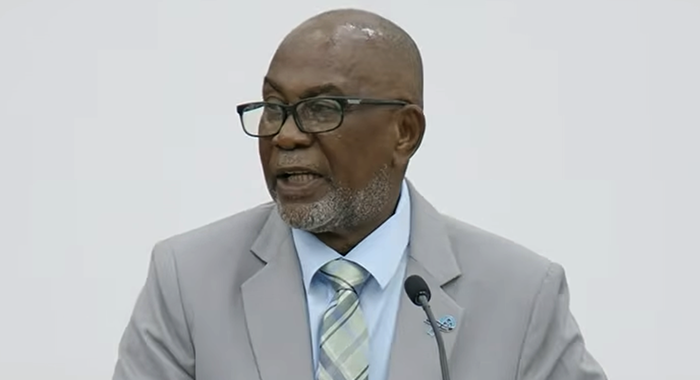
In a candid on-air address to ruling party supporters on Monday, St. Vincent and the Grenadines’ Acting Prime Minister St. Clair Leacock has issued a stark warning: the newly installed New Democratic Party (NDP) administration is facing deliberate, hidden obstruction from public sector officials who are working covertly to derail the government’s policy goals.
Speaking during *New Times*, the NDP’s weekly radio broadcast, Leacock — who also holds the national security portfolio — detailed what he calls systemic institutional resistance and internal sabotage across key state agencies. He described a pattern of behavior where public officials offer warm, agreeable words to sitting ministers to build trust, while quietly working to slow or block reforms out of a desire to see the new government fail.
Leacock recounted a conversation with a fellow cabinet minister who had reached the same conclusion about one senior public servant: the official told the minister exactly what he wanted to hear to earn confidence, but their actions offstage pushed against the administration’s agenda. “You develop greater and greater belief in you. But underneath, the undercurrents are going in a different direction,” Leacock said, recounting the minister’s observation. He added that many officials still underestimate the new leadership, falsely believing they can mislead ministers, fake progress on policy priorities, and sabotage outcomes without consequence.
Leacock’s accusations came during a broad discussion of the administration’s ongoing challenges: the government is working to stabilize the national economy, bring down a towering debt-to-GDP ratio, and meet international monitoring standards set by the World Bank, which recently completed a country assessment. Beyond these well-documented fiscal pressures, Leacock says the government is fighting an uphill battle against bureaucratic inertia and in many cases, intentional obstruction that keeps even basic government functions from moving forward.
Going further, the acting prime minister claimed that the most effective opposition to the NDP is not the formal parliamentary opposition, which he describes as weak and directionless. Instead, he argued, the opposition vacuum is being filled by dissident voices within the government and ruling party itself — people who once campaigned for political change, but are now actively undermining the administration from within. “Some of our people, who you think would know better — because we are not void or afraid of criticism — instead of constructively advancing conversations favourable to an administration struggling with the situation, you have literally usurped the role of the opposition,” Leacock said. He added that even within NDP ranks, some partisans selectively back only favored party members while abusing others, deepening internal divisions.
Much of the public criticism the administration currently faces, Leacock argued, is “unwarranted, impatient, unfounded, and in some cases totally nonsensical,” rooted in a toxic “dangerous cocktail” of ignorance and arrogance. It was this need for open, direct conversation with the public that led Leacock to take over the weekly *New Times* radio slot previously hosted by NDP leader and Prime Minister Godwin Friday. “I believe it is necessary that we have these conversations, and be open to the criticisms and for the explanations, because in the absence of that, people have a right sometimes to speculate,” he explained. “Governmental politics and opposition politics is two different politics. This is where the tyres hit the road, and we have to deal with the reality that’s in front of us.”
Leacock saved his harshest rebuke for public officials using their government positions to quietly derail the administration’s agenda. While he declined to name specific agencies or individuals, he made clear that disciplinary and personnel changes are already in motion, with more decisive action coming once obstruction patterns are confirmed. “You’re going to find more and more that is going to happen, where we find that there are stumbling blocks, other hindrances to getting the government policies going forward,” he said. “When people cry foul, you have to say, ‘Well, too bad.’”
The acting prime minister framed this crackdown on internal resistance as a core part of the administration’s broader push to overhaul long-entrenched government culture. He called out “a lot of BS” in state agencies, where even routine tasks are blocked by unnecessary red tape or deliberate foot-dragging. Leacock traced this harmful mindset to the previous administration, which he claimed prioritized holding political power “at all costs”, leaving remnants of that self-serving culture embedded across the public service.
Leacock also linked internal obstruction to two key priorities of his national security brief: cutting violent crime and attracting foreign investment. He noted that some actors are still “playing games with the government” to prevent new ministers from succeeding in their portfolios, warning that ongoing public disorder — including recent violent incidents involving schoolchildren and persistent gun crime — damages the country’s investment climate. “When that happens, you are disturbing the investment climate in St. Vincent and the Grenadines, where people get the perception that this is a disorderly country in which my money is not safe, or which someone feels not safe to go there,” he said.
Despite the array of challenges, Leacock emphasized that the NDP administration remains fully committed to delivering on its election mandate to the Vincentian people. He asked the public for “more time and more patience”, noting that the government is working to reverse 25 years of what he calls mismanagement by the previous government. The administration is committed to pursuing reform “the right way” even as it confronts massive debt pressure, urgent social demands, and hidden resistance across the state apparatus.
“This is a government that is going to deliver in the shortest possible time the expectations of the people,” Leacock said. “But we are asking for more time and more patience as we do it the right way. We don’t want to mess up on it.”