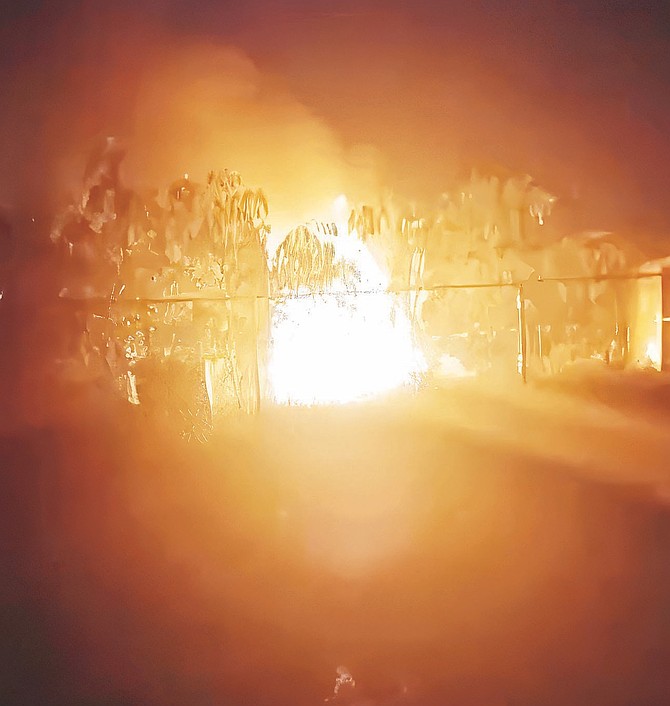
Early on Tuesday morning, a powerful lightning strike during an overnight tropical storm ignited a destructive blaze at a key transformer serving Bahamas Power and Light’s (BPL) rental generation facility in Blue Hills, leaving large portions of New Providence without power for hours. The fire, which broke out just after 5:30 a.m., was contained to the power station’s southwestern sector but caused catastrophic damage to the 25 MVA transformer at the center of the incident.
Kennard Whyms, BPL’s station manager, explained that the lightning bolt made contact with critical infrastructure connected to the facility’s Aggreko-managed rental generation plant, creating a cascading electrical fault that forced all active generating units currently carrying grid load to automatically trip offline. “One of the isolators is burnt,” Whyms noted, pointing to a nearby utility pole that remained smoldering hours after local firefighters fully extinguished the blaze. “When the lightning strike occurred, it actually created a fault on the system at the plant, causing the other units that were on load to come off load.”
Local fire officials received the alert for an active electrical fire just before 6 a.m., immediately dispatching two fire engines to the Blue Hills site. Crews quickly confirmed the fire was isolated to the transformer and brought it under control, though by that point the equipment had already sustained irreversible, extensive damage. Preliminary investigations confirmed the transformer is privately managed by an electrical contractor, whose on-site leadership told investigators they already suspected lightning as the root cause.
On-site footage captured by BPL reveals the full aftermath of the blaze: blackened, melted metal components, scattered charred debris, and wiring burned beyond repair. Technical assessments from BPL found the lightning strike superheated the mineral oil housed inside the transformer, causing the liquid to boil and force its way out through a compromised pressure relief valve, which fueled the spread of the fire.
The outage disrupted power service for communities across nearly all of New Providence, and created unplanned disruptions for local schools. Despite challenges ranging from campus-wide blackouts to flooding at multiple sites, Education Minister Chester Cooper confirmed all schools opened as scheduled Tuesday morning. “We teach resilience, and we don’t allow a spry of rain or electricity being off in one area to stop the show,” Cooper said, adding that individual campus administrators were empowered to make site-specific safety decisions if conditions warranted closure.
The widespread disruption has reignited long-simmering criticism of the Bahamian government’s management of New Providence’s aging power grid from the opposition Free National Movement (FNM). FNM Deputy Leader Shanendon Cartwright acknowledged that extreme weather events like thunderstorms are outside of government control, but argued the incident exposes dangerous gaps in infrastructure protection and backup capacity. “Thunderstorms and lightning strikes are foreseeable realities in The Bahamas — not rare or unimaginable events,” Cartwright said.
He is demanding full public transparency on multiple key questions: the current condition of lightning protection and surge suppression systems at the Blue Hills facility, the level of redundant backup capacity built into the island’s transmission network, and what targeted infrastructure upgrades will be implemented to prevent a repeat outage. “The government must now present a comprehensive power-resilience strategy that includes modern lightning-protection systems, stronger transmission safeguards, adequate redundancy, rapid-response protocols and transparent reporting following every major outage,” Cartwright added.
Cartwright emphasized that widespread outages carry far more serious consequences than minor inconvenience, noting risks to temperature-sensitive food and pharmaceutical supplies, lost revenue for local small businesses, disrupted access to critical public services, and direct safety threats to residents who rely on electrically powered home medical equipment. “A lightning strike may be an act of nature,” he said. “A fragile grid without sufficient protection, redundancy and resilience is a failure of planning.”
Local residents have also voiced widespread frustration on social media, with many sharing repeated experiences of power disruptions during routine bad weather and questioning BPL’s long-term reliability. One user wrote on the social platform X: “Lightning strikes all over the damn world, but BPL seems to be the only power company who friggen blows up every time there’s an inkling of a thunderstorm.”
Despite the extensive damage to the transformer, BPL announced it had completed restoration power to all affected customers by 9 a.m. Tuesday, beating its initial projection that full service would be restored by noon at the latest. Whyms confirmed crews were working around the clock to bring all tripped generating units back online and fully stabilize the grid following the incident.