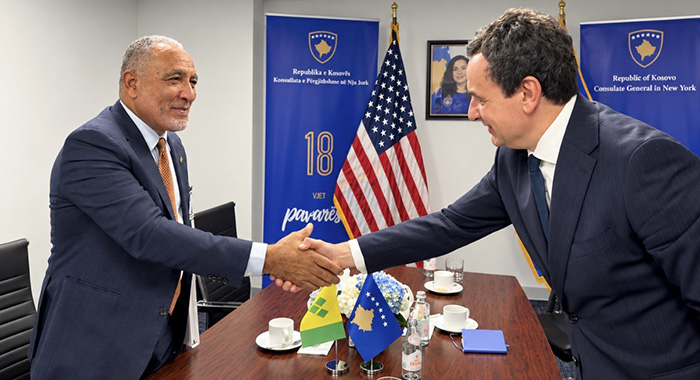
Against the backdrop of the 81st United Nations General Assembly in New York, two key diplomatic engagements led by Dr. Godwin Friday, Prime Minister of St. Vincent and the Grenadines (SVG), have advanced international dialogue on sovereignty, small-state cooperation, and climate action.
In a bilateral meeting with Kosovo Prime Minister Albin Kurti held on the UNGA sidelines, the two leaders centered discussions on Kosovo’s long-standing request for formal recognition as an independent sovereign state, alongside exploring pathways for future bilateral partnership.
The conversation opened with a reflection on shared experiences of small nations navigating global governance, with Friday grounding SVG’s perspective on self-determination and sovereignty in the country’s colonial history and the legacy of Garifuna resistance to outside rule. For his part, Kurti laid out the full context of Kosovo’s claim to recognition: referencing its 2008 declaration of independence, the 2010 International Court of Justice advisory opinion that ruled the declaration did not violate international law, and the ongoing European Union-facilitated normalization dialogue between Kosovo and Serbia.
Friday made clear that SVG holds sympathy for Kosovo’s request, but emphasized that no final decision would be made without extensive domestic and regional consultations. No formal commitment to recognition was issued during the meeting, a point confirmed by official accounts of the discussion.
Beyond the recognition question, the two leaders identified multiple promising areas for practical collaboration. Kosovo highlighted its expanding digital technology sector, developed tourism infrastructure, and specialized search-and-rescue capabilities as areas for potential partnership. In response, Friday expressed SVG’s strong interest in deepening digital cooperation, and outlined the core priorities SVG holds as a small island developing state (SIDS): building robust climate resilience, strengthening disaster preparedness frameworks, and securing access to rapid emergency financing in the aftermath of climate-driven natural disasters. Kurti responded by affirming Kosovo’s willingness to advocate for greater global attention to the acute climate vulnerabilities that threaten SVG and other SIDS across the globe. By the end of the meeting, both sides agreed that continued open engagement and collaborative exploration of shared interests would benefit both small states, regardless of the eventual outcome of the recognition discussion.
In a separate diplomatic meeting on the margins of the General Assembly, Friday also held talks with Austria’s Federal Chancellor Christian Stocker and Austria’s UN Ambassador Gregor W. Koessler focused on strengthening bilateral ties between SVG and Austria. Friday was joined for the meeting by senior SVG diplomatic officials: Dwight Fitzgerald Bramble, the country’s minister of foreign affairs, foreign trade, foreign investment and diaspora affairs, and Vynnette Frederick, SVG’s permanent representative to the United Nations.
The meeting concluded with the signing of a bilateral memorandum of understanding that establishes a formal framework for deepening cooperation across multiple priority areas. Discussions between the two delegations centered on advancing peace and multilateral cooperation, addressing the unique structural challenges that SIDS confront, progressing climate resilience and post-disaster recovery efforts, and expanding access to development and disaster-related financing. Friday used the engagement to highlight SVG’s ambitious renewable energy goals, including ongoing exploration of geothermal energy potential and emerging opportunities in wave energy, as the country works to strengthen national energy security and accelerate its transition to a sustainable, climate-resilient energy system.