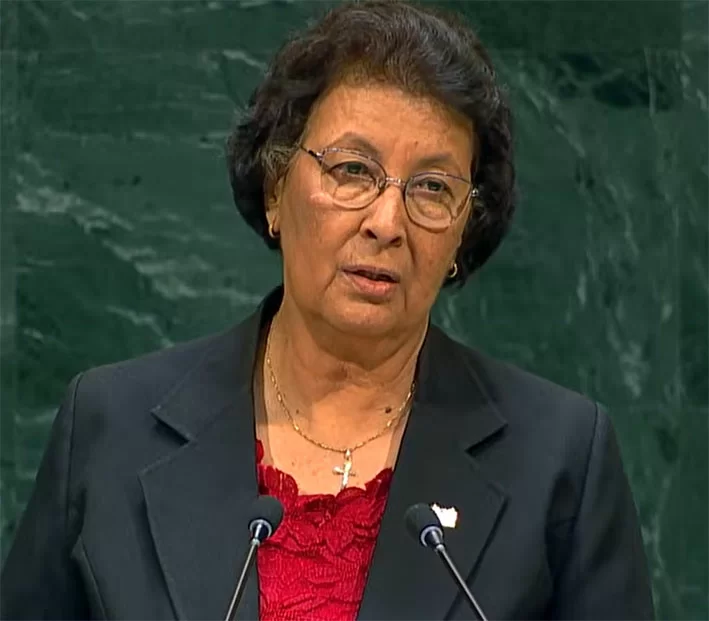
At the 81st United Nations General Assembly General Debate in New York, President Jennifer Simons delivered a wide-ranging address centered on forest conservation, sustainable resource development, global conflict resolution, institutional reform and climate justice, addressing pressing challenges facing small and vulnerable states against this year’s summit theme “Restoring trust, managing transformation: A United Nations that delivers for all”.
Opening her remarks on environmental protection, Simons drew attention to the growing threats facing the world’s remaining intact rainforests, noting that her country – where over 90% of territory is covered by forest and which already holds carbon-negative status – faces emerging pressure from actors seeking to clear large swathes of old-growth rainforest for industrial-scale agriculture. This adds to long-standing risks from extractive industries targeting gold, diamonds and other mineral resources that Simons first warned of one year prior. She emphasized that the global climate finance framework is deeply flawed: nations with high forest cover and low deforestation rates should not be required to lose their natural carbon sinks to qualify for international climate funding, a systemic bias that penalizes early conservation action.
To counter these threats, Simons revealed that her administration is rolling out new legal and institutional frameworks to strengthen forest protection and safeguard the traditional territories of Indigenous and Tribal communities. These reforms center on centering Indigenous traditional knowledge and community participation at every stage of development planning, recognizing Indigenous peoples as the most effective stewards of intact forest ecosystems. “We must stop large-scale forest clearing, and we welcome all international support to advance this goal,” Simons said.
Turning to the country’s offshore oil and gas reserves, Simons struck a balanced tone, acknowledging that these natural resources present a unique opportunity to accelerate national development and lift living standards for all citizens. But she warned against the risk of overreliance on fossil fuel extraction, stressing that “we must convert temporary resource wealth into lasting national prosperity.” Under the government’s plan, resource revenues will be invested strategically to broaden and diversify the domestic economy, rather than funding short-term spending. The energy transition will also balance fossil fuel development with expanded renewable energy deployment, with renewables remaining a core component of the country’s long-term energy mix alongside gas-to-shore and gas-to-power infrastructure projects.
Moving to global peace and security, Simons delivered a blunt assessment of the United Nations’ current shortcomings, noting that the body has failed to adequately prevent or end ongoing armed conflicts around the world, eroding public and state trust in the multilateral system. For small and vulnerable states, a rules-based international order is not a political priority but a matter of survival, she said: consistent application of international law is foundational to advancing peace, security, human rights protection and sustainable development everywhere. Conflicts do not stay contained within their battlefields, she added: disruptions to global energy markets triggered by war push up energy and food prices worldwide, inflicting harm on communities thousands of miles from active conflict zones.
Against this backdrop, Simons called for a renewed commitment to the core principles of the UN Charter and the peaceful resolution of all international disputes. She specifically called out the long-running economic, commercial and financial embargo on Cuba, noting that the Cuban people bear the direct negative costs of the policy, and urged all relevant parties to pursue dialogue and negotiation to end the embargo. On Haiti, Simons called for sustained international support to help the country restore security, constitutional order and democratic governance, stressing that all solutions must center the needs and priorities of the Haitian people.
Simons also renewed long-standing calls for comprehensive reform of the UN Security Council, arguing that the body must become more representative, accountable and effective to address 21st century challenges. She expressed strong support for permanent Security Council representation for African nations, and called for greater representation for small island developing states and low-lying coastal developing countries, which are disproportionately impacted by climate change despite contributing next to nothing to global emissions.
Reparations and restorative justice for the harms of slavery and colonialism also featured prominently in Simons’ address. She argued that the global conversation has moved beyond debating whether these systems of exploitation created lasting, intergenerational harm – the focus now must shift to how those harms can be remedied, and what form reparative action should take. She highlighted the 10-point plan for restorative justice developed by the Caribbean Community (CARICOM) as a key framework for moving forward.
Looking ahead to regional leadership, Simons announced that her country is already preparing to assume the CARICOM presidency in 2027, identifying food and energy security, climate resilience, improved connectivity, the free movement of skilled workers and the streamlined flow of goods and services as core practical priorities for the regional bloc. She also reaffirmed the importance of cross-border collaboration through regional bodies including CARICOM, the Community of Latin American and Caribbean States (CELAC), the Amazon Cooperation Treaty Organization (ACTO) and the Brasilia Consensus.
On emerging challenges, Simons called for proactive planning to manage the rise of artificial intelligence, noting that AI offers transformative opportunities for inclusive development but must be governed responsibly to mitigate downside risks. She also warned that with just four years remaining to meet the 2030 Sustainable Development Goals (SDGs), the world is falling badly behind on its commitments. Achieving the SDGs will require greater political will, lasting peace, improved climate and development finance, technology transfer and expanded international cooperation, she said, adding that global stakeholders must already begin planning for a post-2030 global development framework.
Closing her address, Simons referenced the upcoming selection process for a new UN Secretary-General, noting that for the first time in history, a female candidate from the Caribbean has been put forward for the role, with the full backing of CARICOM. She closed with a call to large, influential UN member states to prioritize the preservation of global peace, stressing that only a United Nations capable of guaranteeing universal peace and security can deliver tangible progress and benefits for all nations, large and small.