Despite boasting a robust pipeline of infrastructure proposals and ample access to global capital, the Caribbean region continues to struggle to translate development ideas into investment-ready, financially viable projects capable of enduring economic volatility, political shifts, and multi-decade operational timelines. That key finding took center stage during a dedicated session at the 2024 Caribbean Infrastructure Forum (CARIF), titled “The Mechanics of Bankable Projects: How To Best Use the Tools Available”, which brought together top leaders from regional banking, development finance, and global advisory to outline pathways for attracting larger volumes of private capital to the region’s critical infrastructure sector.
Speaking at the panel, Kemar Polius, Senior Director and Head of Corporate Banking and Sustainable Finance at CIBC Caribbean, framed project bankability as fundamentally rooted in investor confidence. “Capital follows confidence: confidence in project sponsors, confidence in long-term cash flows, confidence in regulatory frameworks, and confidence in contractual agreements,” Polius explained. With a presence across 10 Caribbean markets and a track record of leading or arranging more than $1.5 billion in infrastructure deals over the past 10 years — supporting high-priority assets including ports, airports, and hospitals — Polius noted that most project failures occur long before financing proposals reach commercial lenders.
“Where we see projects stall or collapse is long before they come to us for a term sheet or final financing approval. The bottleneck is almost always on the project preparation side,” he said, pointing to common gaps including incomplete feasibility studies, unresolved regulatory permitting, and fragmented or inconsistent regulatory frameworks that erode investor trust. “We are not short of project ideas, and we are certainly not short of available capital, as the strong attendance here at CARIF proves. The missing piece is consistent, high-quality project preparation.”
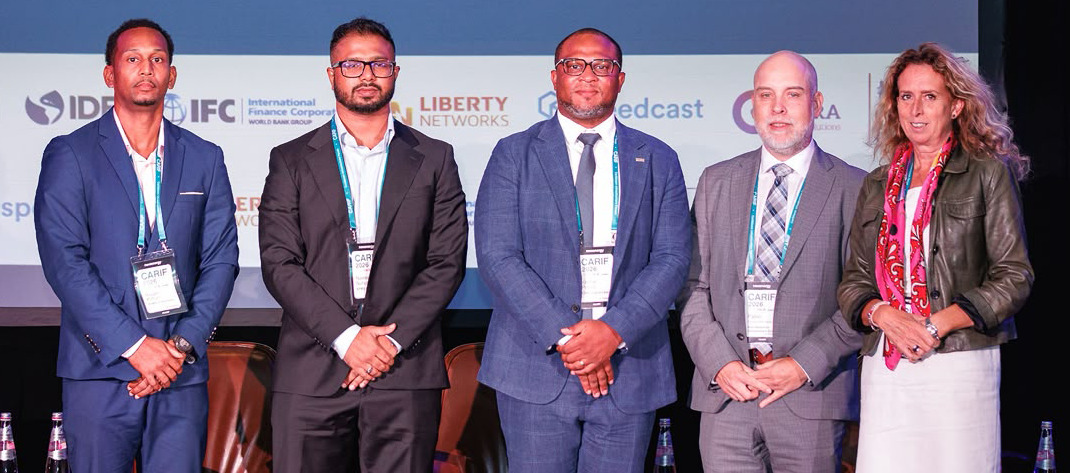
The session, moderated by Victoria Miles, Founding Partner of ImpactA Global, assembled a cross-sector panel of experts including Polius, Roger Kirton (Director of Deal Advisory at KPMG Barbados and the Eastern Caribbean), Naweed Nuhuman (Director of Deal Advisory for KPMG CARICOM), and Pablo Pereira dos Santos (Principal for Public-Private Partnerships at the Inter-American Development Bank, IDB). Panelists explored a range of mechanisms available to governments seeking to mobilize private investment, including public-private partnerships (PPPs), blended finance structures, risk guarantees, and strategic risk allocation. Across all discussions, however, participants consistently circled back to the non-negotiable importance of early-stage preparation, predictable revenue streams, credible regulatory and contractual frameworks, and assigning risk to the stakeholder best positioned to manage it effectively.
Polius also warned against the common pitfall of aligning long-lived infrastructure projects with short political election cycles. “Many projects stall out because they are designed to fit the term of a single administration, but infrastructure assets by their nature operate across decades,” he said. “The contractual frameworks that underpin these projects absolutely must stand the test of time and survive political transitions.” He cited the $300 million Prince George Wharf redevelopment project in The Bahamas as a successful model: the project maintained consistent momentum across multiple changes in government and continued construction through the peak of the COVID-19 pandemic, which brought unprecedented disruption to the Caribbean’s core tourism sector. At the project’s opening ceremony, three consecutive Bahamian prime ministers were in attendance, a visible demonstration of the cross-administration continuity that builds long-term investor confidence.
Pereira dos Santos echoed this assessment, noting that political and institutional continuity is particularly critical given the extended timelines of major infrastructure development. A complex project can require three to six years of preparation before it even reaches the market for financing, he explained, and the resulting operating concession can extend for 30 years or more. “When you sign the final agreement, the project isn’t over — it’s just getting started,” he said.
The discussion also covered the rising use of blended finance, and the role that multilateral development institutions play in helping projects reach financial close. Polius described concessional financing and partnerships with multilaterals as valuable “accelerators” that can support early-stage project preparation, strengthen government institutional capacity, and provide guarantees and other risk-mitigation tools that make projects attractive to commercial investors. However, he emphasized that development finance should complement, rather than replace, private commercial capital, outlining three core principles to guide this collaboration: additionality (confirming concessional support is necessary for the project to move forward), targeting (ensuring the intervention addresses a specific identified risk), and proportionality (matching the level of support to the actual need).
Pereira dos Santos reinforced this view, noting that blended finance delivers the greatest value when it is used to address residual risks after a project has already been fully prepared and structured. “Finance cannot fix all the foundational flaws an underprepared project has. Trying to do that is a guaranteed recipe for failure,” he said.
Limited project scale remains an additional persistent challenge for the Caribbean, where many high-priority projects in emerging sectors like renewable energy are relatively small by global investment standards. Panelists identified project aggregation and the development of repeatable, predictable project pipelines as key strategies to address this barrier, allowing investors to aggregate smaller assets into larger, more attractive investment bundles. Kirton emphasized that regional governments need to move beyond publishing generic lists of infrastructure ambitions to give investors the clarity they require. “Investors don’t just want to see a laundry list of desired projects. They need prioritized proposals, completed preparation, clear procurement processes, stable regulatory frameworks, and a visible pipeline that lets them plan long-term capital deployment,” he explained.
The session also highlighted a growing shift in investment interest beyond traditional Caribbean infrastructure assets such as airports, seaports, and tourism-related developments. Panelists noted that renewable energy, water infrastructure, climate-resilient construction, and digital infrastructure are all attracting rising attention from global investors.
For the Caribbean, unlocking this wave of new capital will depend less on proving that infrastructure is needed — a case that is already widely accepted — and more on consistently delivering well-prepared projects that investors can confidently back over the long term. As Polius summed up, the core requirements for success are straightforward but non-negotiable: credible project sponsors, predictable long-term cash flows, durable contractual agreements, and regulatory environments built to last.