Newly released public contractual documents and a 10-year business plan have cast fresh clarity on the complex structure behind a controversial large-scale agricultural development project in Suriname, confirming that Mennonite farmers who migrated to the country for the initiative do not hold any formal stake in the state land agreement at the heart of the project.
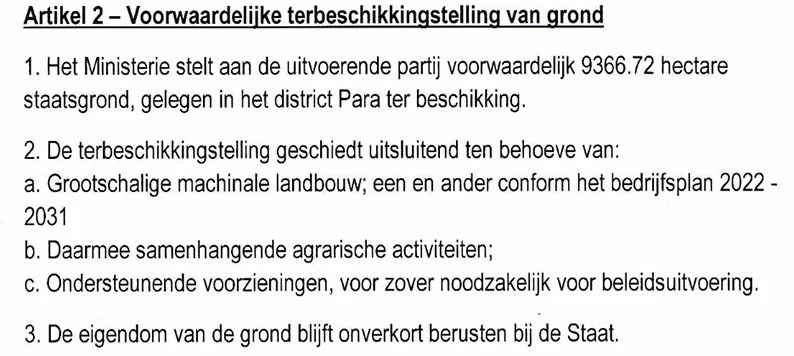
The deal, signed January 13, 2026, between Suriname’s Ministry of Agriculture, Livestock and Fisheries (LVV) and local entity Braganza Marketing Group N.V. — the firm that recruited the Mennonite farmers to work on the project — grants the company conditional use rights to 9,366.72 hectares of state-owned land in Suriname’s Para district for an initial 20-year term. The land remains the formal property of the Surinamese state, and Braganza holds a non-transferable right to use the plot exclusively for large-scale mechanized agriculture and related agribusiness activities. Under the terms of the agreement, Braganza is required to bring at least 10 percent of the total allocated area under cultivation every year to retain its access rights. What makes the arrangement notable is that despite the Mennonite farmers being central to the project’s on-the-ground implementation, their names do not appear anywhere in the formal public contract between LVV and Braganza.
LVV Minister Mike Noersalim had previously stated that his ministry never entered into a separate agreement with the Mennonite community, noting that the ministry’s contract was exclusively with the Surinamese registered firm for the production of commodity crops including soybeans and corn, and that Braganza did not present itself as a representative of the migrating farmers during negotiations. Braganza, however, has publicly confirmed its plan to rely on Mennonite agricultural workers for the project’s two core sites: one group of Mennonites from Belize for the Tibiti site, and a second contingent from Mexico for the Kabalebo site.
During a recent visit to the Tibiti area by members of Suriname’s National Assembly and journalists, Peter Petersen, a Mennonite leader from Belize, explained that his group was recruited to Suriname by Lionel Blokland and Ruud Souverein, two figures connected to Braganza. Petersen said his community sold all of their assets in Belize and shipped heavy farm machinery to Suriname under the expectation that they would be able to operate large-scale farms on the Para district land. His group, he added, expects to use more than 9,000 hectares and has agreed to pay $150 per hectare for access, though details of who receives this payment and what contractual rights the group holds remain unclear.
Braganza’s 2022-2031 business plan, also made public, shows that plans for the Tibiti and Kabalebo sites have been in development for nearly a decade, with the firm explicitly outlining its goal to produce soy and corn across the two concessions. The plan also highlights the project’s international backing, naming Adrian Barbero of Bolivia-based Rural Real Estate Investments Ltd. (RREI) as a lead initiator. According to the document, RREI brings more than 30 years of experience investing in large-scale agriculture and livestock operations across South America, with a track record of developing and acquiring large agricultural concessions across multiple regional countries where “agricultural specialist colonies” operate. While the plan does not explicitly confirm these colonies refer to Mennonite communities, it is now verified that Braganza has specifically recruited Mennonite farmers to carry out on-ground work for its Suriname projects. RREI, alongside Blokland, is listed as a stakeholder in Braganza Marketing Group, with international investors planning to contribute their own capital to develop agriculture, livestock, and dairy projects across the allocated Surinamese land.
The disclosures confirm a clear structural separation: the Surinamese state has granted land access to Braganza, not directly to the Mennonite farmers, who are only involved as contracted workers through the local firm. Crucially, no details of the private agreement between Braganza and the Mennonite community — including terms for land use, per-hectare payments, investment responsibilities, or profit sharing — appear in the public contract with LVV or the released business plan. This lack of transparency raises regulatory questions, as the LVV-Braganza agreement explicitly bans transferring use rights to any third party without the ministry’s prior written approval.